
Why it matters
The producer
At thirteen, Adi Badenhorst made his first wine at Buitenverwachting in Constantia under winemaker Jean Daneel. He studied oenology at Elsenburg Agricultural College, spent a vintage at Groote Post on the West Coast, then nine years as winemaker at Rustenberg in Stellenbosch, where he made the Peter Barlow Cabernet Sauvignon among other wines. In 2008 he and his cousin Hein bought a 60-hectare run-down farm in Paardeberg, Swartland, planted with some of the oldest Grenache vines in the region. They called it Kalmoesfontein. The property has since grown to over 180 hectares across Kalmoesfontein and Jakkalsfontein, with old unirrigated bushvines of Chenin Blanc, Grenache, and Cinsault planted mostly in the 1950s and 1960s.
The house approach is deliberate: biological farming, native yeast fermentation, whole-bunch handling for every grape variety, and no more than 25% new oak. These are not incidental choices. They are the basis of a regional community Adi helped found.
Place and vineyards
Where the wines begin
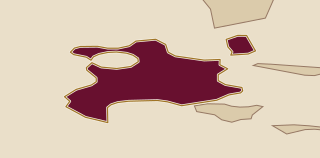
Paardeberg is a granite hill in the Swartland, the broad dryland wheat-and-wine country north of Cape Town. The Swartland sits far from the cooling ocean breezes that shape Stellenbosch and Constantia. Summers are hot and dry; rainfall comes mostly in winter; the land is poor enough that vines are rarely irrigated. That dryness concentrates the fruit in old bushvines and keeps yields naturally low.
Kalmoesfontein and Jakkalsfontein sit on Paardeberg, where granite soils drain quickly and force vine roots deep. The farms hold over 180 hectares, with plantings of Chenin Blanc, Grenache, and Cinsault going back to the early 1950s.
In the cellar
Vineyards and cellar
The vines across both farms are old bushvines planted in the 1950s and 1960s to Chenin Blanc, Grenache, and Cinsault. All are unirrigated and farmed as biologically as possible. In the cellar, whole-bunch handling means every grape variety, red and white, enters fermentation without being destemmed or crushed. For white wines this preserves aromatic freshness and adds texture; for reds it can bring spice and grip alongside the fruit. Fermentation runs on native yeasts. New oak is capped at 25%, keeping the old-vine fruit character audible rather than submerged under wood.
Wines to know
The range in view
The range divides between the Secateurs tier and the Kalmoesfontein estate wines. Secateurs Chenin Blanc draws from a broad base and offers pure, aromatic drinking with mandarin and pear drop on the nose, a lighter and more forward style than the estate whites. Kalmoesfontein White Blend is Chenin-led with spices, tea, stone fruit, and citrus blossom; the other estate whites include Kelder Steen, a Chenin-led blend with haunting lemon and herb aromatics and fresh pear on the palate.
Among the reds, Ringmuir Cinsault is made entirely through carbonic fermentation from 1960s-planted vines, giving wild strawberry and cherry fruit with herbal tea complexity. The Grenache from the 1951 vines stands as the estate's oldest-vine wine, carrying the site character of Paardeberg more directly than any other bottle in the range.
A useful way in
A bottle to begin with
Kalmoesfontein White Blend is the bottle to open first. It is a Chenin-led estate wine from Paardeberg old vines, fermented whole-bunch with native yeasts. The nose carries spice, tea, stone fruit, and citrus blossom, and the palate holds that breadth across a long, dry finish. This is Chenin Blanc grown in heat and dryness rather than the Loire's cool river air, and the difference is in the weight and aromatic density that old unirrigated Swartland vines produce. The wine shows what the farm is doing at estate level before the single-variety bottlings take the range into narrower ground.