
Why it matters
The producer
In 1980, the Lena family took over a dormant abbey in Castelbuono and announced they intended to build a model winery. The abbey had been founded in 1100 by Count Ruggero d'Altavilla as a Benedictine house, and monks had cultivated the land for centuries before the estate fell quiet. The Lena family's ambition was practical from the start: restore the vineyards, plant both autochthonous Sicilian varieties and international grapes, and pursue a farming philosophy rigorous enough to earn DEMETER biodynamic certification, the international authority for biodynamic production. The estate bottles around 250,000 wines a year from within the boundaries of Madonie Park, one of the protected mountain territories of northern Sicily.
Place and vineyards
Where the wines begin
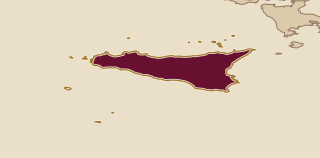
Castelbuono sits in the Madonie Mountains in Palermo Province, well above the coastal plains where most of Sicily's high-volume wine production concentrates. The park designation means the surrounding landscape is managed for ecological integrity, and the estate operates within those boundaries. At mountain elevations, the growing season runs cooler and longer than on the coast, preserving acidity in both white and red grapes. Grillo, the native Sicilian white variety, holds its citrus and floral character more easily here than in the sun-bleached lowland vineyards. Nero d'Avola, Sicily's most important red variety, ripens more slowly, building colour and tannin without losing freshness.
In the cellar
Vineyards and cellar
The estate grows both autochthonous Sicilian varieties and international grapes. Nero d'Avola and Grillo represent the native side. Chardonnay represents the international plantings. The biodynamic framework under which the estate operates eliminates synthetic pesticides and fertilisers and organises field work around the lunar calendar, which divides days into categories based on which part of the plant is understood to be most active. Fermentation and cellar work follow from the fruit that biodynamic viticulture produces: grapes harvested from vines farmed without chemical inputs, at mountain altitude, where natural conditions already limit disease pressure and reduce the need for intervention.
Wines to know
The range in view
The estate produces wines from Nero d'Avola, Grillo, and Chardonnay, with the range spanning red, white, and rosé across Sicilian appellations. The Grillo Sicilia is a dry white from one of Sicily's most characterful native varieties: pale-coloured, with citrus and white stone fruit and a clean, saline finish that mountain-grown fruit maintains well. The Sensoinverso Chardonnay Sicilia shows how the estate handles an international variety at altitude, producing a white with more freshness and acidity than lowland Sicilian Chardonnay typically carries. The Nero d'Avola Rosato Sicilia takes the island's main red variety and draws it into rosé, where the grape's colour and fruit translate into a pale wine with red berry character and the bright acidity that Madonie altitude preserves.