
Why it matters
The producer
Abdyika is a 14-hectare estate in the Struma River Valley, southwestern Bulgaria, founded in 2005 near the Greek border. Four mountain ranges ring the valley. The winery built its range around the ancient local grape Broad Leaved Melnik, adding Melnik-55 and Ruen, a cross between Broad Leaved Melnik and Cabernet Sauvignon, to complete its red wines. Chenin Blanc and Assyrtiko are the white varieties.
Every vineyard task is done by hand. No machinery enters the parcels. Swedish consulting winemaker Lars Torstenson has shaped the cellar since 2001, four years before the winery was formally registered.
Place and vineyards
Where the wines begin
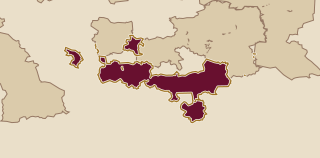
The Struma River Valley cuts through southwestern Bulgaria between the Rila, Pirin, Osogovo, and Konyavska mountain ranges. The valley floor is sheltered and dry; summer heat is real, and rainfall is low enough that unirrigated vines spend part of every growing season under drought stress. That stress is not a problem for Broad Leaved Melnik, which evolved in this valley and handles dry conditions without yield collapse. The late ripening season, pushed by the heat and the mountain walls that trap warmth into autumn, concentrates the grape without pushing alcohol at the expense of the fruit's cherry character. The proximity to Greece and the Mediterranean to the south adds warmth that northern Bulgarian appellations do not share.
Abdyika's parcels are unirrigated, with mineral-rich soils. Deep root systems pull moisture and mineral complexity from below the dry surface. The four surrounding ranges also moderate temperature swings, giving cooler nights that hold acidity in the grapes through the long ripening window.
In the cellar
Vineyards and cellar
Abdyika farms 14 hectares entirely by hand. Harvesting, canopy work, and fruit selection all rely on human judgment rather than mechanical timing. In a dry mountain valley, the ability to assess each vine individually matters: Broad Leaved Melnik's late ripening means harvest decisions come in autumn when conditions can shift quickly. Manual harvesting allows selective picking at the moment each parcel is ready.
The estate's stated philosophy is that red wines are made in the vineyard, not the cellar. This is not a dismissal of cellar work; it is a commitment to fruit quality as the primary input. Melnik Premium 2021 was aged in oak, producing the pepper, mocha, and roasted wood nuances in the finished wine, but the fruit weight, tannin character, and 14.5% alcohol came from the vineyard first.
Wines to know
The range in view
Abdyika's range is organized around the Melnik grape family, with two whites completing the lineup.
Broad Leaved Melnik produces lighter, fruit-forward reds: light ruby color, medium body, Morello cherry and strawberry on the nose, with the fruit carrying more weight than the tannins. These wines are for early drinking.
A useful way in
A bottle to begin with
Start with the Melnik Premium 2021. It is an 85% Melnik, 15% Cabernet Sauvignon red, oak-aged, 14.5% alcohol, with ripe cherry, blackcurrant, pepper, and mocha aromas, silky but firm tannins, and a long finish. It is the wine where Abdyika's manual farming, unirrigated parcels, and Torstenson's cellar work all show at once. The Cabernet Sauvignon adds frame to the Melnik's fruit, and the oak is present without being dominant. Drink it now for the fresh fruit weight, or hold it for three to five more years as the tannins settle. No other bottle in the range shows the same depth.