
Why it matters
The producer
Adega Cartuxa is the wine arm of the Fundação Eugénio de Almeida, a cultural and educational foundation based near Évora in the Alentejo. The estate dates to 1896 and was refurbished in the 1950s by Eugénio de Almeida, whose name the foundation now carries. Its purpose is practical as well as agricultural: the income from wine supports the foundation's work in arts, education, and social services across the Évora region.
The range runs from the accessible Foral de Évora and EA lines up to Cartuxa and, at the top, Pêra-Manca, a nineteenth-century Portuguese wine brand that ceased production after 1920 and was brought back in 1990 following years of experimental work in the vineyards and cellar during the 1970s and 1980s. The estate now produces around 7 million bottles a year across its five properties.
Place and vineyards
Where the wines begin
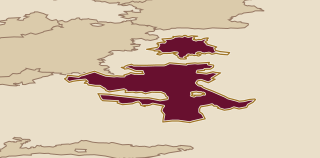
The estate operates near Évora, the walled Roman city at the heart of the Alentejo plateau. Alentejo is Portugal's largest wine region and its most continental in character: hot, dry summers with low rainfall, and winters that can be sharp. Those conditions push the grapes toward full ripeness and concentrated fruit, with the warmth showing clearly in the red wines.
The five properties, Pinheiros, Casito, Álamo de Cima, Álamo da Horta, and Quinta de Valbom, spread the estate's holdings across different parts of the region. Quinta de Valbom has the longest documented wine history of the five, with records of wine production at the site going back to 1776.
In the cellar
Vineyards and cellar
The estate's holdings across five properties give the winemaking team a broad base of fruit from different parts of the Évora area. Sources differ on the precise total: some cite around 300 hectares, others point to over 600 hectares across all five named properties. The range that comes from those vineyards reflects the full span of Alentejo grape varieties, both red and white.
Pêra-Manca white, made from white Alentejo varieties, is full-bodied and slightly herby, with noticeable texture. The red Cartuxa shows an earthy, savoury character with spice and warmth. Foral de Évora red, drawn from the same regional fruit, is brighter and more immediately fruity, built for earlier drinking.
Wines to know
The range in view
The range has a clear ladder. Foral de Évora sits at the entry level, offering approachable red and white wines from Alentejo varieties. The EA line adds a step, and Cartuxa is the core mid-range label, with both a red showing earthy spice and a darker savoury character. Pêra-Manca sits at the top in both colours: a white that is full, rich, and slightly herby with notable texture, and a red that carries more concentration and weight than anything else in the range. Annual production across all labels runs to around 7 million bottles.
The Foral de Évora red opens with vivid raspberry and blackcurrant fruit, fresh and lively, with a palate that stays bright rather than heavy. It is the most straightforwardly fruity wine in the range and shows how ripe Alentejo fruit can be without the wine becoming dense.
A useful way in
A bottle to begin with
Cartuxa red is the bottle that shows what the estate does with its Alentejo fruit. It is not the rarest wine in the range, but it is where the house character is most clearly drawn: savoury, earthy, spiced, with warmth built into the fruit rather than sitting on top of it. The vivid raspberry character of Foral de Évora steps back here, replaced by something denser and more structured. Pêra-Manca carries more weight still, but at considerably more difficulty to find. Cartuxa red gives the full register of the estate at a realistic entry point into the upper part of the range.