
Why it matters
The producer
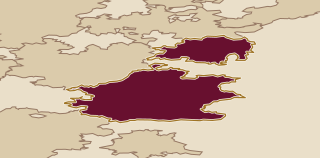
Adega Cooperativa de Figueira de Castelo Rodrigo sits at the far northeastern edge of Portugal, in a landscape pressed between the Serra da Marofa and the Spanish border. One hundred and fifty-four farmers founded it in 1956, pooling their harvests into a shared cellar in a town that most wine buyers outside Portugal have never heard of. Today approximately 1,000 members farm around 1,050 hectares across the Castelo Rodrigo subregion of the Beira Interior DOC, producing roughly 10 million litres each year, 55 percent white and 45 percent red.
The cooperative markets under the name Adega Castelo Rodrigo and carries several labels: Torre de Aguiar, Castelo Rodrigo, Convento de Aguiar, Frei Bernardo, and Marofa. The bottle that has travelled farthest on international markets is Abrigados Reserva, a co-fermented red field blend built from four native Portuguese varieties and, in its 2023 vintage, carrying organic certification.
Place and vineyards
Where the wines begin
The Castelo Rodrigo subregion is one of three that together form the Beira Interior DOC. It received that full DOC designation in 2005, upgraded from an earlier provisional classification known as IPR. Before the regulatory upgrade, it was wine country in practice if not in law: the territory around Serra da Marofa has an unbroken winegrowing record stretching back to the 12th century.
The climate here is warm and continental, shielded from Atlantic influence by the mountain ranges to the west. Summers run dry and hot. That warmth pushes ripeness and delivers the weight the subregion is known for. Full-bodied, spicy reds are the signature style, a character shaped directly by the dry growing season and the high solar exposure of the subregion's slopes. White wine accounts for the majority of the cooperative's output by volume, but the reds are full-bodied and spicy.
In the cellar
Vineyards and cellar
The 1,050 hectares farmed by cooperative members are dry-farmed, relying on winter and spring rainfall rather than irrigation. Summer drought stress limits yields and concentrates sugars and colour in the grapes before harvest. The Abrigados Reserva is produced from organic-certified fruit, carrying certification on the 2023 vintage.
The defining cellar practice for Abrigados Reserva is co-fermentation: the four red varieties in the blend are harvested together from mixed-planting parcels and fermented as a single lot. This continues the traditional Castelo Rodrigo approach of growing Touriga Nacional, Tinta Roriz, Touriga Franca, and Alfrocheiro side by side rather than in separate blocks. Co-fermentation means the varieties interact from the moment the grapes enter the vat, integrating their aromatic and structural contributions during fermentation rather than after blending. Abrigados Reserva is full-bodied and spiced.
Wines to know
The range in view
The cooperative's output runs across five label families: Torre de Aguiar, Castelo Rodrigo, Convento de Aguiar, Frei Bernardo, and Marofa. These cover both whites and reds at various price and quality tiers, reflecting the full range of grapes and parcels managed by 1,000 members across 1,050 hectares.
Abrigados Reserva sits at the top of the range and is the cooperative's international-market flagship. The 2023 blend is 55 percent Touriga Nacional, 15 percent Tinta Roriz, 15 percent Touriga Franca, and 15 percent Alfrocheiro. Touriga Nacional is the dominant voice: it brings deep colour, dark aromatic concentration, and the firm backbone. Tinta Roriz adds red-fruit weight and density of colour. Touriga Franca opens the aromatic register with a violet and floral lift. Alfrocheiro contributes additional colour depth and a fresh red-fruit note that prevents the wine from reading as purely dark and extracted. Together the four varieties produce a red that is full-bodied, warm, and spiced, with aromatic complexity driven by the high proportion of Touriga Nacional and textural grip from dry-farmed fruit.
A useful way in
A bottle to begin with
Abrigados Reserva is the bottle to start with. It is a co-fermented field blend of Touriga Nacional, Tinta Roriz, Touriga Franca, and Alfrocheiro from dry-farmed, organic-certified parcels in the Castelo Rodrigo subregion. The 2023 vintage is available at Systembolaget. In the glass it is full-bodied and spiced, with dark fruit, violet lift, and firm dry tannin. The high proportion of Touriga Nacional gives the wine genuine aromatic weight, while the Touriga Franca keeps the nose from being purely dark. Start with this bottle to understand the subregion's warm continental character, the traditional mixed-planting approach, and what co-fermentation does to a four-variety red from northeastern Portugal.