
Why it matters
The producer
In 1955, Borba was a marble town with a wine problem. Growers were selling their grapes to middlemen on terms they could not control, receiving prices with no relation to what the wine fetched when it left the region. On April 24 that year, the Agriculture Guild of Borba invited a group of those growers to talk through an alternative. Six days later, on April 30, 1955, they constituted Adega de Borba: a cooperative, owned by the growers, with production and sales in their own hands. State support came from the Junta Nacional do Vinho, which had begun promoting cooperatives as a way to modernize Portuguese wine. Adega de Borba was the first to open in Alentejo.
The modernization arc accelerated sharply in 2011 when the cooperative completed a new 140,000 square metre production facility at a cost of €12 million. The investment was a bet on volume and consistency at a moment when Alentejo was gaining international attention. It paid. The Galitos range, built for accessible everyday drinking, now moves through supermarkets and wine retailers in 35 countries.
Place and vineyards
Where the wines begin
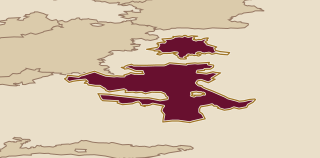
Borba sits in the Alentejo interior, in the sub-zone of the same name within the broader Alentejano designation. The town is set on a plain at altitude, surrounded by white marble outcrops and red schist soils. Summers are long, dry, and hot, with daytime temperatures regularly exceeding 35°C. That heat ripens grapes fully, pushing the regional palette toward ripe dark fruit, ample body, and low to moderate natural acidity in the reds. The 2,200 hectares managed by cooperative members divide 70% red and 30% white, reflecting where the climate advantage sits.
Borba's marble geology shapes the vineyard conditions directly. The pale stone reflects heat, raises temperatures around the vine rows, and drains well. The combination accelerates ripening and contributes to the dense, warm character of reds from this corner of Alentejo.
In the cellar
Vineyards and cellar
Member growers farm under cooperative protocols across 2,200 hectares of Borba and the surrounding Alentejo sub-zone. Aragonez (the Alentejo name for Tempranillo), Trincadeira, and Castelão dominate red plantings. All three ripen fully under Alentejo summer conditions: Aragonez brings red fruit and density, Trincadeira adds dark berry, spice, and tannin grip, Castelão contributes color and a slightly earthier fruit register.
In the modern facility, red wines ferment with pump-over maceration for color and tannin extraction. Galitos Red macerates for seven days at 25°C before malolactic fermentation and stabilization, producing a clean, fruit-forward wine ready for early drinking. The barrel inventory holds over 1,200 casks for wines requiring oak ageing.
Wines to know
The range in view
Galitos is the cooperative's public-facing range, built for daily drinking at accessible prices. The red blends Castelão, Trincadeira, and Aragonez into a warm, medium-bodied wine: dark plum, ripe cherry, and a dry finish with moderate tannin from seven days of pump-over maceration. Alcohol runs at 13.5%. The white and rosé versions of Galitos follow the same direct, fruit-forward register using white Alentejo varieties.
Above Galitos, the range steps into oak-aged cuvées where Aragonez and Trincadeira develop more depth, spice, and length. These wines spend time in the 1,200-plus barrel inventory and carry a year or two of bottle age before they open fully.
A useful way in
A bottle to begin with
Galitos Red is the right first bottle. It blends Castelão, Trincadeira, and Aragonez at a price point requiring no patience or extended cellaring. In the glass, it gives Alentejo's characteristic warmth: ripe dark fruit, soft tannin built by seven days of pump-over maceration, low acidity, and a dry finish at 13.5% alcohol. It is a table wine in the oldest sense, made to sit beside food. Pour it with lamb chops, grilled chouriço, or aged sheep's milk cheese and it performs exactly as intended: direct, fruit-led, and complete.