
Why it matters
The producer
When Joana and António Maçanita founded Adega Macanita Vinhos in 2011, they arrived with a question the Douro rarely asked of itself: which assumptions about vine age, vineyard hierarchy and grape grades were actually correct, and which were received wisdom nobody had tested? António is a practising oenologist, and the estate at Quinta Senhora do Carmo in Covas do Douro became the ground for working those questions out through farming and cellar decisions rather than through received convention.
The winery sits in the Cima Corgo, the middle Douro sub-region above Régua that produces some of the valley's most concentrated old-vine material. The Maçanitas draw from parcels in both Cima Corgo and Baixo Corgo, and the work in the vineyard starts earlier and more deliberately than much of the region: careful pruning and selective harvest are the two quality controls they name first, before the grapes reach the cellar.
Place and vineyards
Where the wines begin
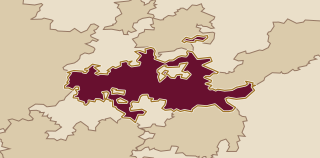
Covas do Douro is a village in the Cima Corgo, the middle of the Douro's three sub-regions running upstream from the Spanish border. The Cima Corgo occupies a geographical sweet spot between the lower Baixo Corgo, where rainfall is slightly higher and the wines tend to be lighter, and the Douro Superior further east, where the continental climate pushes ripeness and alcohol higher. Cima Corgo schist holds heat but drains fast, forcing vine roots deep and reducing yields naturally.
For a producer focused on freshness, the Cima Corgo address is a deliberate choice. The sub-region's altitude variation and its mix of schist and granite give growers more options to balance ripeness against acidity than the hotter upper valley allows. The Adega Macanita vineyards include Baixo Corgo parcels as well, which add a slightly cooler, Atlantic-influenced note to the blend palette.
In the cellar
Vineyards and cellar
Pruning is the first decision at Adega Macanita Vinhos, and the one that carries the most weight. In the Douro, where summer heat and low rainfall can push sugar accumulation fast, the number of buds left on the vine after winter pruning determines the potential crop load, the rate at which the fruit develops, and whether the harvest can be timed to achieve ripeness with acidity still in balance. A vine left with too many buds in the Cima Corgo will ripen quickly and unevenly; a vine pruned hard will develop more slowly and give the farmer more control over pick timing.
Selective harvest follows from that discipline. Rather than stripping the vine in one pass, selective picking allows each parcel to be harvested at the point that suits its exposure, aspect, and vine age. For old vines on schist, where different varieties within a field blend ripen at different rates, that flexibility changes what arrives in the cellar.
Wines to know
The range in view
Adega Macanita Vinhos produces still red and white wines from Cima Corgo and Baixo Corgo parcels under the Douro appellation. The red wines draw on old-vine field blends: Touriga Nacional, Touriga Franca, Tinta Roriz, Tinta Barroca, and Tinto Cão are the confirmed varieties of the Cima Corgo's pre-war plantings, with additional varieties typical of the valley's mixed plots. White wines from the region draw on Viosinho, Rabigato, Moscatel Galego and Gouveio, the standard upper-valley white varieties that contribute different aromatic registers and levels of acidity.
The range positions the wines toward freshness rather than power: lower alcohol than much of the valley, with fruit character shaped by old-vine root depth rather than ripeness-led winemaking. The red wines carry the weight and dark fruit typical of Cima Corgo schist plots, but with acidity and grip that keeps them at the table rather than overwhelming it. The whites, grown on schist and granite, tend toward dry, aromatic styles with enough texture to carry food.
A useful way in
A bottle to begin with
The old-vine Cima Corgo red is the wine that explains what Adega Macanita Vinhos is trying to do. It is a field-blend Douro red from parcels with vines over ninety years old on schist, carrying Touriga Nacional, Touriga Franca, Tinta Roriz, and Tinta Barroca together. The nose is dark and mineral, the palate firm with natural tannin and a bright acid line, giving the wine more energy than its body weight suggests. It is a food wine: structured enough to stand against lamb or game, but fresh enough to work alongside roast fish or something braised.