
Why it matters
The producer
Adelsheim Vineyard sits in the Chehalem Mountains, a compact volcanic and sedimentary ridge northwest of Newberg that rises above the broader Willamette Valley floor. David and Ginny Adelsheim purchased 19 acres there in 1971, when the sub-appellation had no commercial winery at all. When the winery opened in 1978 it was the first in the Chehalem Mountains, and the estate has farmed the area ever since.
Today Adelsheim grows Pinot Noir, Pinot Gris, Chardonnay, and Pinot Blanc across 11 vineyard sites totaling more than 200 acres, most of them inside the Chehalem Mountains AVA. Gina Hennen has directed winemaking since 2017, and Rob Alstrin serves as CEO. The winery produces approximately 50,000 cases per year, all from estate-farmed fruit.
Place and vineyards
Where the wines begin
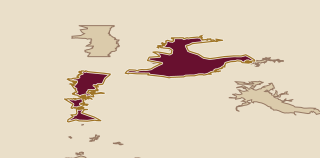
The Chehalem Mountains AVA is a distinct sub-appellation within the Willamette Valley, Oregon's principal cool-climate wine region. The ridge runs northeast to southwest between the Tualatin Valley and the Yamhill River lowlands, and its vineyards sit between roughly 200 and 1,000 feet in elevation. That range of altitude means cooler temperatures on the upper slopes and warmer pockets lower down, which translates directly to differences in ripeness, acidity, and aromatic concentration across the estate.
Adelsheim's two largest confirmed estate sites illustrate this spread. Ribbon Springs, 125 acres acquired in 1995, and Boulder Bluff, 15 acres acquired in 2003, together represent different elevations and soil contacts within the mountain range. Farming across varied soil types within one AVA gives the cellar enough material to build a range from a single home territory.
In the cellar
Vineyards and cellar
Adelsheim farms 11 sites across more than 200 acres, overwhelmingly within the Chehalem Mountains AVA. The concentration of vineyards inside a single sub-appellation is a deliberate choice: the range is built around one address rather than spread across the Willamette Valley for variety. At that scale, the cellar team can farm each parcel for a specific purpose rather than blending across unrelated sites.
Ribbon Springs at 125 acres is the largest holding. Boulder Bluff at 15 acres is smaller and may be used for a more specific cuvee or for blending into the core range; the sourced record does not confirm the separation. Current winemaker Gina Hennen has spoken publicly about the estate's commitment to sustainable farming, though specific certifications beyond that framing are not confirmed. The cellar work is directed at making wines that reflect the Chehalem Mountains address: cool-climate acidity, restrained fruit weight, and the kind of aromatic clarity that comes from harvesting at moderate ripeness rather than waiting for maximum sugar accumulation.
Wines to know
The range in view
The four core varieties at Adelsheim are Pinot Noir, Pinot Gris, Chardonnay, and Pinot Blanc. Pinot Noir is the estate's most important grape by reputation and almost certainly by volume, planted across multiple sites at different elevations to give the cellar a range of ripeness and tannin character. Chehalem Mountains Pinot Noir from these sites tends toward red fruit rather than dark, with firm acidity, moderate tannin, and a mid-weight body that falls between the lighter Dundee Hills style and the richer examples from the warmer Ribbon Ridge or Eola-Amity Hills.
Chehalem Mountains Pinot Noir opens with red cherry, dried cranberry, and a herbal edge that comes from cool-climate growing conditions rather than underripeness. In the mouth the acidity arrives early and stays through the finish, framing fruit that is bright rather than heavy. Tannin is present but fine-grained on the Jory and Willakenzie soils, and the wine closes with a mineral dryness rather than a sweet oak impression.
A useful way in
A bottle to begin with
The Chehalem Mountains Pinot Noir is the right first bottle. It is the variety the estate was built around, grown on the sub-appellation the winery helped establish, and made in a style that demonstrates what cool Oregon growing conditions actually produce. Expect red cherry, earth, and firm acidity rather than the dark-fruited richness of warmer New World Pinot. The tannin is present without being harsh, the finish is dry and clean, and the wine is approachable on release but has enough acid to develop over three to five years. One bottle clarifies both the Chehalem Mountains address and what Oregon Pinot Noir can be when it is not pushed toward maximum ripeness.