
Why it matters
The producer
Åhus Vingård sits in Åhus, a small town on Skåne's Baltic coast, and it runs on an arrangement that is rare in European wine: 150 private individuals each hold rows in the vineyard, work their parcels through the growing season, and receive wine from the harvest. It is not a cooperative in the traditional sense. It is closer to a working share in Sweden's wine culture, administered by four partners who took ownership in 2016.
The vineyard was founded in 2005, when commercial wine production in Sweden was still an experiment. Skåne, the country's southernmost province, accounts for 80% of all Swedish wine output today. The varieties planted here are modern cold-hardy hybrids: Solaris and Phoenix for whites, Léon Millot, Rondo, and Regent for reds. These are not compromise grapes. They were bred for short growing seasons and Baltic coast conditions, and at Åhus they produce wines that are light-bodied, aromatic, and clearly northern in character.
Place and vineyards
Where the wines begin
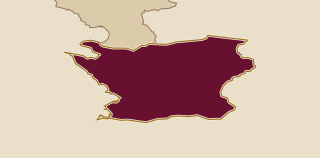
Skåne is Sweden's southernmost region, separated from Denmark by a narrow strait. The Baltic coast around Åhus brings cool summers, steady maritime winds, and a short harvest window. Classic Vitis vinifera varieties such as Pinot Noir or Riesling would not ripen reliably here. The hybrid grapes at Åhus carry frost resistance and earlier budbreak built into their genetics, which translates into commercially viable fruit most years.
The Baltic coast climate also shapes what ends up in the glass: wines that lean toward fresh acidity, herbal and citric aromatics, and moderate body. The Solaris white and the Bobblor sparkling both show this directly. The reds from Léon Millot are aromatic and fruit-forward rather than tannic or full-weighted.
In the cellar
Vineyards and cellar
All 4,000 vines are tended collectively by the 150 participants who hold rows. The grape varieties are modern hybrids developed for cool European climates: Solaris and Phoenix ripen early and carry disease resistance, which matters in Skåne's wet maritime summers. Léon Millot and Rondo both produce pigment-rich, aromatic fruit in northern conditions where Pinot Noir would give thin, underripe wine.
Cellar practice details are not published. The wines are sold through Systembolaget, Sweden's state retail monopoly, which requires standard food-safety and labeling compliance. No oak character appears in the published taste profiles, and no élevage details are available from verified sources.
Wines to know
The range in view
Solaris is a white wine in the range. The 2023 carries green gooseberry, fresh herbs, green apple, and citrus peel on a notably fresh palate. Solaris is a frost-hardy cross bred in Germany; in Skåne it produces herbal, citric whites with bright acidity rather than the tropical weight it can show in warmer climates. Phoenix also appears in the range as a secondary white variety.
Bobblor is a sparkling wine. The 2023 shows green apple, pear, gooseberry, mineral tone, and lime. The mousse and acidity carry the wine; the aromatics are clean and northern, with no richness or autolytic character from extended lees contact.
A useful way in
A bottle to begin with
The Jubilee NV is a non-vintage blend of Léon Millot and Rondo, two hybrid reds that cover different ground: Léon Millot brings aromatic fruit and lift, Rondo brings body, plum depth, and tannin. Together they produce a wine that is fleshy and juicy, with berries and plums, a clean palate, and a slight savory twist at the finish. The wine drinks easily, with satisfying fruit and a clean close. That savory twist at the end gives it slightly more length than the single-varietal Léon Millot.