
Why it matters
The producer
Alberto Ballarin grows Nebbiolo on roughly 7 hectares spread across three Barolo communes, La Morra, Monforte d'Alba, and Novello, and sells wine under a label that carries a family name with roots in Alba going back generations. The winery is new as an independent operation: Alberto split from the shared family estate, Cascina Ballarin, at the end of 2021 and launched his own label the following year. Before that, he had spent two harvests working elsewhere, in Australia's Barossa Valley in 2016 and in South Africa in 2017, before returning to Piemonte. Those years abroad inform the way he approaches the cellar without breaking from Barolo's core requirements.
The farm behind the label is older. Pietro Viberti Ballarin built Cascina Ballarin in 1928 as a working farmhouse with stables, barns, fruit trees, and vineyards. In 1985, Luigi Viberti and his sons Giorgio and Giovanni converted Cascina Ballarin into a dedicated winery. Alberto is the next step: a single producer separating his share of that inheritance and building a range on his own terms.
Place and vineyards
Where the wines begin
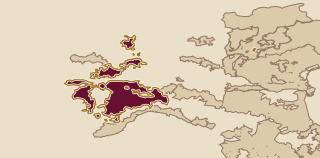
Barolo is a DOCG zone in the Langhe hills of Piemonte, built around Nebbiolo grown on clay-limestone soils in eleven communes. The appellation sits south of Alba, and the differences between communes are real and worth tracking on a label.
Alberto's home base is La Morra, a high ridge commune whose Tortonian marl and limestone soils produce Nebbiolo that tends toward floral aromatic lift and relatively early drinkability compared to the southern communes. The standard Barolo blends La Morra fruit with parcels from Monforte d'Alba and Novello, which adds weight and firmer grip to the blend.
In the cellar
Vineyards and cellar
The standard Barolo draws from vines aged between 25 and 45 years across La Morra, Monforte d'Alba, and Novello. Older vines in this age range produce smaller, more concentrated clusters with less water per berry, which translates into deeper color and more concentrated fruit character in Nebbiolo.
Fermentation takes place in stainless steel, which preserves primary fruit aromatics without adding oak influence at that stage. The wine then moves to French oak barriques for 14 months, followed by 12 months in large Slavonian oak barrels, totaling 26 months in wood before bottling. The two-vessel sequence is a moderate approach: barrique adds fine-grained tannin and some vanilla-spice character, while large Slavonian oak allows the wine to breathe and integrate without contributing much oak flavor of its own.
Wines to know
The range in view
The range centers on Nebbiolo in Barolo. Two bottles currently define it.
The standard Barolo DOCG is a multi-commune blend from La Morra, Monforte d'Alba, and Novello. The three origins give the wine breadth: La Morra contributes floral lift and relative approachability, while Monforte and Novello add body and firmer tannin. The wine shows garnet-orange color on release, with rose and violet on the nose alongside spice, and a palate of soft but firm tannin balanced by bright acidity and good persistence. The 26 months of combined oak ageing meets the standard Barolo minimum and leaves the wine with enough wood integration to frame the Nebbiolo without obscuring it.
A useful way in
A bottle to begin with
Start with the standard Barolo DOCG. It is a multi-commune Nebbiolo aged 26 months in French barrique and Slavonian oak, built from vines between 25 and 45 years old across La Morra, Monforte d'Alba, and Novello. In the glass it gives rose, violet, dried cherry, and spice on the nose, then a palate of firm but not rigid tannin, bright acidity, and a long finish with iron and spice. The three communes mean it captures several angles of the appellation in one bottle: aromatic lift from La Morra, firmer tannin from Monforte. It is the wine that shows what Alberto Ballarin does with Nebbiolo before the single-vineyard Bussia narrows the focus.