
Why it matters
The producer
In 1999, a British wine importer and a New Zealand winemaker arrived in Veneto not to buy a property but to build a sourcing model from scratch. David Gleave, a Master of Wine based in the UK, and Matt Thomson, a winemaker from New Zealand, had a specific argument: that the Veneto was producing good grapes from good hillside sites and selling most of them into a bulk-production system that rewarded volume over care. Their answer was to go directly to those growers, pay for hillside fruit, and bring cool-chain, fruit-first cellar technique to varieties the commodity trade was treating as interchangeable. Alpha Zeta was the result.
The philosophy has not shifted. The portfolio runs from Prosecco and Soave through Chardonnay and Pinot Grigio to Ripasso and Amarone della Valpolicella. Prices stay accessible. Screwcap closures go on everything, a deliberate choice about freshness rather than tradition.
Place and vineyards
Where the wines begin
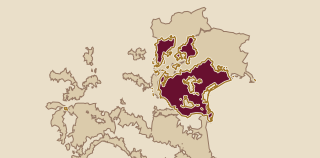
The Pinot Grigio comes from the Alpone Valley, a narrow corridor in eastern Veneto that sits within the broader Soave zone. The key commune is Monteforte d'Alpone, where the hillside soils are granite and decomposed volcanic rock. Both soil types drain well, limit vine vigour, and force roots to work. On flat, fertile ground, Pinot Grigio yields easily and loses character; on volcanic hillsides it ripens more slowly, holds acidity, and produces a denser, more aromatic fruit. The granite and basalt base also contributes a mineral edge that flatland versions rarely carry.
Soave production draws from the same eastern zone. The Valpantena Valley, northwest of Verona, supplies grapes for the red wines, including the appassimento-based Ripasso and Amarone della Valpolicella DOCG. The two valleys give Alpha Zeta its geographic spread: whites from the volcanic east, reds from the hillside terrain closer to the city.
In the cellar
Vineyards and cellar
Pinot Grigio grapes from the Alpone Valley are hand-harvested. The hillside location limits mechanisation and allows selective picking by maturity. At the winery, grapes go directly into a pneumatic press, a gentle extraction method that avoids breaking seeds or skins and limits the bitter phenolic extraction that can coarsen a Pinot Grigio. The juice is immediately cooled to preserve volatile aromatics, then fermented in temperature-controlled stainless-steel tanks. No oak is used. The approach is designed to keep the peach and pear fruit clean and the flint mineral edge intact rather than adding texture or complexity from wood.
The same stainless-steel, no-oak approach applies across the white wines and Prosecco. Ripasso and Amarone follow the conventional Valpolicella production methods: Ripasso referments the base wine on the partially dried grape skins left over from Amarone production, adding colour, body, and dried fruit depth; Amarone uses fully dried grapes, a process that concentrates sugars, flavour, and alcohol over several months before pressing and fermentation.
Wines to know
The range in view
The range moves in a clear arc from light and early-drinking to weighty and structured. Prosecco opens the lineup: Glera grapes from the Veneto, made by the Charmat method with secondary fermentation in tank, producing fine mousse, apple and white flower aromas, and a clean, low-alcohol finish. Soave and Chardonnay sit alongside the Pinot Grigio in the white wine tier, all vinified in stainless steel, all made without oak ageing, all built for drinking within a few years of vintage.
The Pinot Grigio from Monteforte d'Alpone is the white wine with the most defined source character: volcanic and granite soils, hillside sites, hand-picking, and cool fermentation give it a fuller mid-palate than typical flatland versions, with ripe stone fruit and a mineral edge that persists on the finish.
A useful way in
A bottle to begin with
The Pinot Grigio from the Alpone Valley comes from hillside vineyards in Monteforte d'Alpone. It is a single-variety white wine from hillside volcanic and granite soils in Monteforte d'Alpone, hand-harvested, pneumatically pressed, fermented cold in stainless steel, and sealed under screwcap. In the glass it delivers ripe peach and pear with a clear flint edge, a full mid-palate, bright acidity, and a clean finish. Nothing about it is disguised by oak or sweetness. It shows exactly what the sourcing model was designed to produce: hillside character, variety definition, and freshness at an everyday price.