
Why it matters
The producer
Alto Estate makes only red wine. That has been true since Manie Malan, the founder's son, fermented the first vintage on the steep Helderberg hillside above Stellenbosch in 1922. The name comes from the Latin for high: the vineyards climb to around 300 metres, which is steep by Stellenbosch standards. Cabernet Sauvignon grows across the majority of the estate's ninety-plus hectares and anchors all three wines in the range.
Five winemakers have worked the estate across more than a century. The current winemaker, Bertho van der Westhuizen, follows a minimal-intervention approach, farming the altitude and granite so that the wines carry the Helderberg's signature: graphite, fynbos and composed dark fruit rather than the soft, warm-climate reds more common at lower elevations.
Place and vineyards
Where the wines begin
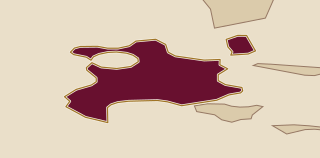
Alto sits within the Helderberg sub-region of Stellenbosch, on slopes that face south toward False Bay. Local producers refer to a stretch of elevated, south-facing hillside here as the Golden Triangle, and Alto's vineyards occupy a prime section of it. Atlantic air moves inland off the bay through most of the growing season, pulling temperatures down in the afternoon and slowing ripening. The combination of altitude, ocean wind and the granite and schist soils underneath is what separates Helderberg Cabernet from the broader Stellenbosch category: the wines tend toward firmer tannin, higher acidity and a minerally, almost saline edge rather than the rounder, plum-forward profile of warmer valley floors.
For Alto, that geography is directly audible in the wines. The fynbos note on the Estate Blend nose and the graphite line running through the Cabernet Sauvignon both trace back to the same source: high granite slopes cooled by a sea breeze.
In the cellar
Vineyards and cellar
Cabernet Sauvignon occupies the majority of the ninety-plus hectares under vine, with Shiraz and Cabernet Franc filling smaller parcels that contribute to the blends. Farming on granite at altitude keeps yields modest, which concentrates flavour in the fruit before it reaches the cellar.
Bertho van der Westhuizen's minimal-intervention approach means the cellar work is largely about preservation rather than transformation. Oak is used for aging across the range, with the Estate Blend receiving the most complex treatment of the three wines, but the goal at Alto is to let the altitude and soil do the expressive work. The graphite edge and the fynbos herbaceousness in the wines come from the Helderberg hillside, not from heavy extraction or new wood.
Wines to know
The range in view
Alto Rouge, the founding blend, combines Cabernet Sauvignon with Shiraz and Cinsault. It is the most accessible wine in the range: the tannins are firm but composed, and the fruit sits in cherry and raspberry territory rather than the darker, more tannic register of the varietal Cabernet. The 2024 vintage adds a savouriness to the nose, with sumac and charcuterie alongside the cherry, and an umami undercurrent on the palate that lifts the red fruit and gives the wine more interest than its price would suggest.
Alto Cabernet Sauvignon is the estate's varietal statement. The 2020 vintage is more concentrated than the Rouge, with red and black cherries on the nose beside fresh blackberry and a distinct graphite edge. In the mouth it is simultaneously smooth and tightly wound: lively acidity, firm complex tannins, and a long dry finish that needs time to open. Five to ten years is a reasonable drinking window.
A useful way in
A bottle to begin with
Start with Alto Rouge. It is the wine Manie Malan made in 1922, and the blend, Cabernet Sauvignon, Shiraz and Cinsault, has not changed in its essentials since. The current vintage opens with cherry, sumac and a charcuterie note, moves to a bright palate of cherries and ripe raspberries with an umami undercurrent, and finishes with firm, composed tannins. It is food-friendly, honest about its grape and place, and priced below what comparable Helderberg reds usually cost. The Rouge gives you the estate's century-long argument in one glass: red wine from a high Stellenbosch slope, made without fuss.