
Why it matters
The producer
Jim Binns spent twelve years, from 2006 to 2017, as assistant winemaker at Sine Qua Non, the Santa Barbara label that Manfred Krankl built into one of California's most closely followed small-production Rhône operations. When Binns left to start his own label in 2012, he named it after his two children, Andrew and Emily, compressing their names into a single word: Andremily.
For the first eight years, Andremily ran on purchased fruit. In 2020, Binns bought Slide Hill Vineyard in Edna Valley, a 39-acre property across three rolling hills and a meadow, with varying slopes, soil types, and exposures. The purchase converted Andremily from a label working with contract growers into an estate with direct control over its fruit. The listed wine, EABA, is a Syrah-led Rhône blend whose grape proportions shift from vintage to vintage. It is the only wine in the range.
Place and vineyards
Where the wines begin
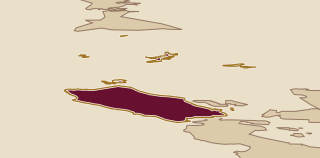
Edna Valley is an American Viticultural Area in San Luis Obispo County, roughly midway between Los Angeles and San Francisco on California's Central Coast. The valley sits close to the Pacific, and the cool marine air from the Pacific extends the growing season and slows ripening. For Rhône varieties, that slower accumulation of sugar and flavour means Syrah and Mourvèdre hold their dark fruit and pepper character without losing freshness.
Slide Hill Vineyard occupies three hills and a connecting meadow within the AVA. The varied slopes and orientations within those 39 acres give Binns different ripening windows and soil exposures across the property, which feeds directly into how the EABA blend is assembled each year.
In the cellar
Vineyards and cellar
Slide Hill Vineyard's three hills and meadow give Binns a range of growing conditions within one property. Varying orientations mean some blocks receive morning sun and others afternoon sun, which changes how quickly fruit develops. The varied soils across the vineyard affect water retention and vine stress, two factors that show up directly in the density and concentration of the final wine.
The cellar work at Andremily is oriented toward small-production quality. Binns assembles EABA from the vintage's available fruit, adjusting the proportion of Syrah, Mourvèdre, Grenache, and occasionally Viognier based on what each year delivers. The Viognier addition, present in the 2020 vintage at 3%, is a technique common in Northern Rhône Syrah production, where the aromatic white grape is co-fermented with Syrah to lift the colour and add floral character to the nose.
Wines to know
The range in view
EABA is the sole wine in the range. It is a red Rhône-style blend with Syrah as the anchor in every vintage. Mourvèdre and Grenache are the secondary grapes, and their proportions shift year to year based on the character of the fruit.
Across four consecutive vintages the blend has moved: 2017 ran 58% Syrah, 28% Mourvèdre, 11% Grenache; 2018 was 59% Syrah, 23% Mourvèdre, 15% Grenache; 2019 moved to 61% Syrah, 24% Mourvèdre, 13% Grenache; 2020 came in at 65% Syrah, 22% Mourvèdre, 10% Grenache, and 3% Viognier. Syrah's share has increased, Mourvèdre holds its position as the structural backbone, Grenache contributes weight and red fruit, and the Viognier addition in 2020 brought a lifted aromatic dimension the earlier vintages did not carry.
A useful way in
A bottle to begin with
Start with the 2020 EABA. The 2020 at 65% Syrah is the most Syrah-forward vintage in the confirmed range, with black raspberry, plum, and coffee on the nose, fine tannin through the mid-palate, and enough weight to pair with lamb or slow-cooked beef.