
Why it matters
The producer
Angelo Negro e Figli has farmed the Roero hills above the Tanaro since 1670, when Giovanni Domenico Negro first cultivated the sandy slopes above the village of Monteu Roero. Three centuries of continuous farming is interesting background. What separates this estate from a long genealogy of Piedmontese family farms is a single decision made by Giovanni Negro in 1971: he bottled Arneis as a dry white wine at a moment when the grape was considered a blending component at best, a weed-suppressor between Nebbiolo rows at worst.
Arneis was disappearing. Growers in Roero had no commercial use for it as a standalone wine, so they planted less of it each decade. Giovanni Negro looked at the grape, saw something worth saving, and bottled it alone. No market existed yet. He built one anyway. The estate has been Arneis's most persistent advocate since, and the grape is now the signature variety of the Roero DOCG white appellation.
Place and vineyards
Where the wines begin
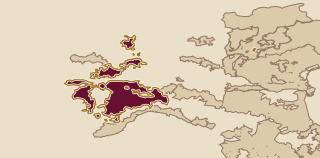
Monteu Roero sits on the right bank of the Tanaro river, directly across from the Langhe hills where Barolo and Barbaresco are made. The two zones look at each other across the water but the soils tell different stories. Langhe soils are mostly calcareous clay. Roero soils are older and sandier, laid down by marine deposits, and they drain faster and warm earlier in spring. Arneis performs differently on those sandy hillsides than Nebbiolo does on the heavier Langhe clays across the river: lighter body, lower tannin, and earlier-drinking whites that carry fruit and flower rather than weight.
In the cellar
Vineyards and cellar
The estate uses different cellar approaches for each grape in the range. Arneis for the Serra Lupini spends time on the lees in stainless steel, which adds weight and texture to a grape that can otherwise run thin. No oak. The lees contact rounds the fruit and gives the wine its characteristic softness without adding flavour from the barrel.
The Angelin Langhe Nebbiolo undergoes floating-cap maceration in stainless steel for 15 to 18 days, which extracts colour and tannin without the intensity of a longer soak or oak contact. The wine then matures for 12 months in stainless steel, keeping the Nebbiolo fruit forward and the tannin accessible earlier than the Barolo would be. This is Nebbiolo vinified for an approachable register.
Wines to know
The range in view
The range covers five core wines across four grapes.
Serra Lupini Roero Arneis DOCG is 100% Arneis from the estate's Roero parcels. Stainless steel fermentation and lees ageing. Straw yellow in the glass. The nose opens with peach, acacia flower, and a thread of tropical fruit. Light-bodied, with the kind of freshness that comes from sandy soils and early picking. Serra Lupini Roero Arneis is 100% Arneis.
A useful way in
A bottle to begin with
Start with the Serra Lupini Roero Arneis DOCG. It is 100% Arneis, fermented and aged on the lees in stainless steel, straw yellow, with peach, acacia flower, and a rounded mid-palate from the lees contact. No oak. Light acidity that stays alive from first sip through the finish. It is the bottle Giovanni Negro made the market for in 1971, and it is the clearest expression of what the Roero hills on their sandy right bank do with a grape that exists almost nowhere else.