
Why it matters
The producer
In 1994, three Mallorcan wine lovers made a decision that went against everything the island's industry was doing: they would make wine exclusively from Mallorca's native red varieties, the grapes that bulk producers and exporters had spent decades quietly replacing with Cabernet Sauvignon and Merlot. Miquel Ángel Cerdà, Pere Obrador, and Francesc Grimalt set up at Son Burguera, a property in the municipality of Felanitx whose winemaking cellars had been in use since the thirteenth century. The project had an explicit argument: that Callet, Manto Negro, and Fogoneu were capable of producing serious wine, and that these three grapes could anchor Mallorca's wine future.
To make that argument credible, they hired Xavier Ausàs as consultant. Ausàs had served as technical director of Bodega Vega Sicilia, Ribera del Duero's most deliberate and long-ageing estate. His presence at a newly founded island project signalled that Ànima Negra intended to work at a different level from most of what surrounded it.
Place and vineyards
Where the wines begin
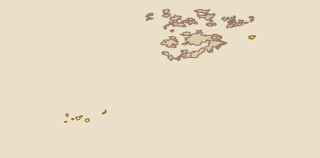
Mallorca sits in the western Mediterranean, off the coast of Valencia. The island's wine history is old, its modern fine-wine history is short. Felanitx lies in the southeast of the island, inland from the coast, in a landscape shaped by dry summers, thin topsoil, and a Mediterranean climate without the cooling Atlantic influence that modifies temperatures on the Spanish mainland.
Dry farming is not a choice here so much as a condition: rainfall is low and irrigation is not available to the old vineyards. That scarcity concentrates what the vine produces. Callet, Mallorca's signature native red grape, responds to this climate by developing bright acidity and a medium-light body rather than the heavy, extracted character that Spanish reds from continental zones often carry. The wines from this island sit apart from Rioja and Ribera del Duero in weight and colour, but they carry their own kind of depth.
In the cellar
Vineyards and cellar
The estate owns 34 hectares and works with up to 70 hectares of supplier vineyards across the island. The owned parcels include old-vine Callet at Son Negre, which provides the fruit for the estate's highest-tier wine. Dry farming across all parcels means the vine root systems work deeper into the soil to find water, and yields stay low without artificial intervention.
Hand-harvesting and selective picking are standard practice. At Son Negre, selectivity is taken further: individual bunches are assessed, and the decision to harvest is made parcel by parcel rather than across a single pass.
Wines to know
The range in view
ÀN/2 is the entry-tier red and the estate's most available wine. The blend is 65% Callet, with Manto Negro and Fogoneu making up the balance alongside approximately 15% Syrah. The Syrah is the only non-native variety in the range; it provides the colour depth and body weight that Callet does not naturally supply at this proportion. Spiced, darkly fruited, and moderately oaked, with cherry, cinnamon, and a mineral edge running through the mid-palate.
ÀN is the core expression, built from old-vine Callet without the Syrah component of the entry tier. It reads brighter and more concentrated than ÀN/2: the Callet character is more exposed, the fruit sits higher in the glass, and the wine carries more potential for bottle development. This is where the native-variety argument is made most directly.
A useful way in
A bottle to begin with
Start with ÀN/2. At 65% Callet supported by Manto Negro, Fogoneu, and 15% Syrah, it gives the fullest picture of the house's working method in a single bottle: native varieties in the lead, a small amount of Syrah for body and colour, and oak ageing that adds spice without dominating the fruit. Dark cherry, cinnamon, smoky minerality, and a clean finish with vanilla from the barrel. It is the most available wine in the range, the most approachable, and the clearest single demonstration of what Ànima Negra is trying to do with Mallorca's native grapes.