
Why it matters
The producer
Mastrojanni is a Brunello di Montalcino estate in Castelnuovo dell'Abate, the village that occupies the far southeastern corner of the Montalcino hill in Tuscany. A Roman lawyer named Gabriele Mastrojanni founded it in 1975, planting Sangiovese on lacustrine clay and sand soils before the appellation had much of a reputation to trade on. The first Brunello went into bottle in 1978.
The estate now belongs to Francesco Illy, a member of the Trieste coffee family, who took personal ownership in November 2022 and has since moved the vines toward organic and biodynamic cultivation. Winemaker Andrea Machetti has held his position since 1992, through two ownership changes, and remains the continuous thread across all three eras of the estate.
Place and vineyards
Where the wines begin
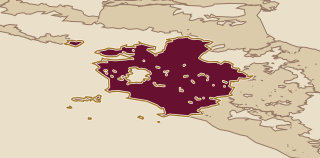
Castelnuovo dell'Abate sits at the southeastern base of the Montalcino ridge, below the medieval hilltop town, facing toward Monte Amiata. Within the Brunello di Montalcino DOCG, the southeastern sector is known for warmer growing conditions than the northern and western parts of the appellation. More sun and less Atlantic wind push Sangiovese toward fuller ripeness and more pronounced tertiary development: the plum, tobacco, truffle, and dried herb notes that appear in wines from this corner come partly from that warmth working on the grape over a long growing season.
Vigna Schiena d'Asino takes its name from the shape of the ridge on which it sits: schiena d'asino means donkey's back in Italian. The plot was planted in 1975, the founding year of the estate, and its vines have never been replanted. Old Sangiovese on this lacustrine soil produces fruit in small quantities with concentrated character.
In the cellar
Vineyards and cellar
Mastrojanni's 41 hectares under vine include 14.4 hectares of Brunello-qualified Sangiovese on south and southeast-facing slopes between 250 and 400 metres. The remaining vineyard is split between other parcels and the La Nascosta property. Since November 2022 the viticulture has moved toward organic and biodynamic methods: a shift away from synthetic inputs toward farming that responds to soil biology rather than correcting for it.
Vigna Schiena d'Asino is handled separately. The plot's age gives it naturally low yields and concentrated Sangiovese. Its production is capped at 500 to 650 cases per year, a fraction of the 3,330 cases produced across the standard Brunello. Machetti has managed both parcels since 1992, which means the cellar decisions that shaped the character of each wine were made by the same person across three decades of ownership.
Wines to know
The range in view
The range is built around two versions of Brunello di Montalcino DOCG, both from 100 percent Sangiovese. Brunello di Montalcino under the DOCG rules requires a minimum of five years ageing before release, including at least two years in oak and four months in bottle. Mastrojanni's standard Brunello draws from 14.4 hectares of Sangiovese across the estate's qualifying slopes. It is a wine with substantial body from the clay soils and the warmth of the southeastern subzone, showing dark plum, strawberry jam, dried hay, tobacco, and truffle character as it develops over time. Tannins are firm and need time to soften.
Vigna Schiena d'Asino is the single-vineyard Brunello, drawn from the original 1975 plantings on the donkey's-back ridge. It is produced in volumes that make it genuinely rare: between 500 and 650 cases most years, compared to ten times that for the standard Brunello. The concentration from those old vines and the specificity of the site give it a tighter, more layered character than the estate wine, though both require patience.
A useful way in
A bottle to begin with
Start with the Brunello di Montalcino rather than Vigna Schiena d'Asino. The single-vineyard bottling is produced in volumes too small for most buyers to locate reliably, and it requires even more time in the cellar before it gives much back. The standard Brunello covers 14.4 hectares of Sangiovese on lacustrine clay and sand, aged through the full DOCG regime before release. A recent vintage in good condition delivers Castelnuovo dell'Abate Sangiovese in its clearest form: plum and dried hay on the nose, firm body on the palate, a long tobacco-edged finish, and the acidity underneath to carry it forward for years.