
Why it matters
The producer
Arianna Occhipinti farms nine named contrade in Vittoria, in the southeastern corner of Sicily, with Frappato and Nero d'Avola as her two central grapes. She started in 2004 at age 22 with one hectare of vines in the locality of Fossa di Lupo. By 2024 the estate had grown to approximately 40 hectares, with 25 certified organic hectares spread across those nine contrade.
Her uncle is Giusto Occhipinti, cofounder of COS winery, who has made wine in Vittoria since 1980. COS was among the first estates to push Sicilian wine toward minimal-intervention farming and fermentation. Arianna arrived at her own first vintage six years after her uncle introduced her to the wider wine world at age 16. She studied oenology in Milan, came back to Vittoria, and discarded the laboratory framework she had been taught. Steel tanks came out. Cement tanks went in. Native yeast fermentation replaced inoculation. Sulfur additions were cut to a minimum.
Place and vineyards
Where the wines begin
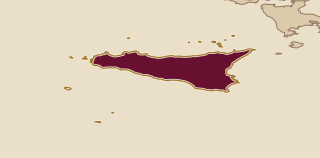
Vittoria sits in the southeastern corner of Sicily, an area of relatively flat terrain and sandy soils with some clay and limestone subsoil beneath. The zone's appellation, Cerasuolo di Vittoria, is one of Sicily's oldest DOCGs, and it is built around a mandatory blend of Nero d'Avola and Frappato. Those two grapes are the native reds of Vittoria, and they behave differently from the varieties planted in the island's cooler, higher interior zones.
Frappato here produces light-coloured red wine with high acidity, red cherry and floral perfume, and low tannin. The warmth of southeastern Sicily ripens the grape early, but the sandy soils drain quickly and moderate the vine, keeping alcohol lower than much of the island. Nero d'Avola on the same terrain deepens colour, adds tannin, and brings a darker fruit register to blended wines.
In the cellar
Vineyards and cellar
All 25 certified organic hectares are farmed biodynamically. No synthetic inputs. Cover crops and biodynamic preparations maintain soil health between vine rows. The nine contrade are managed as separate parcels, each harvested and fermented separately so that vintage and site character come through cleanly in each wine.
In the cellar, cement tanks do the fermentation work for both whites and reds. Cement is thermally stable and porous enough to allow a slow exchange with the cellar air, which keeps fermentation temperatures low without refrigeration and preserves aromatic freshness. Macerations on skin run long: red wines spend weeks in contact with grape skins before pressing, which builds colour, texture, and grip without the harsh tannin of hot extraction. Native yeasts drive all ferments. Sulfur additions are kept minimal, applied only at bottling in most wines. Ageing happens in cement or in large neutral wood, neither of which adds oak flavour to the wine.
Wines to know
The range in view
The range runs from entry blends to single-contrada parcels, with Frappato carrying the most weight across the portfolio.
SP68 Rosso is a Frappato and Nero d'Avola blend named after Strada Provinciale 68, the provincial road running alongside the original vineyard. It is the lightest-coloured red in the range, pale ruby with low tannin, high acidity, and a red cherry and dried herb character. Nero d'Avola adds depth without pushing the wine toward the heavier register of the island's richer reds.
A useful way in
A bottle to begin with
Il Frappato is the bottle to begin with. It is a single-varietal wine from estate Frappato parcels across the nine contrade, made with native yeasts, long skin maceration, and cement ageing. No oak influence. No corrective additions. What is in the glass is the grape and the place.