
Why it matters
The producer
Au Bon Climat is a Santa Barbara County winery that has spent four decades making the case in the glass that California's Central Coast can produce Pinot Noir and Chardonnay on Burgundian terms: measured acidity, proportioned fruit, and enough depth to age. Jim Clendenen co-founded it in 1982 with Adam Tolmach at the Bien Nacido vineyard in the Santa Maria Valley, on a small budget, in a county the wine trade had not yet taken seriously. The winery's name is French for "a good climate," which was less a marketing phrase than a declaration of geographic confidence.
In 1982, Clendenen and Tolmach set up inside a shared facility at Bien Nacido, one of the Santa Maria Valley's largest vineyard properties, and produced their first wines. The regional argument was not obvious to buyers at the time. Santa Barbara County was known mostly as a warm coastal destination; the idea that its inland valleys could produce wines comparable in proportion and acidity to Burgundy took time to prove through accumulated vintages and growing critical attention.
Place and vineyards
Where the wines begin
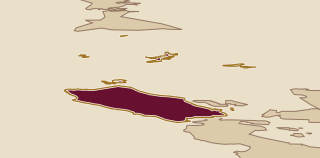
Santa Barbara County sits at the southern end of California's Central Coast, where something unusual happens to the geography. The coastal mountain ranges, which run north-south along most of California's coastline, here angle east-west. The Pacific Ocean does not simply brush the coast; it pushes directly inland through gaps in the mountains, carrying fog and cold air deep into the Santa Maria and Santa Ynez valleys. The growing season runs longer and cooler than most of coastal California, with warm afternoons checked by marine air arriving in the early evening.
For Pinot Noir and Chardonnay, two grapes that lose their defining acidity quickly in heat, this transverse valley geography is consequential. Grapes ripen slowly, holding acid through the growing season. Labels from Au Bon Climat's named vineyards carry Santa Barbara County or, in some cases, the more specific Santa Maria Valley appellation, anchoring the bottles to this coastal geography.
In the cellar
Vineyards and cellar
The range draws from 68 owned acres and approximately 100 acres of leased or controlled land, spread across named parcels in the Santa Maria Valley and surrounding areas. The parcel-level sourcing is central to how Au Bon Climat builds its range: individual vineyards are bottled separately when the fruit justifies it, giving the wines a specific address rather than a blended county character.
For Chardonnay, sur-lie barrel ageing is confirmed across the range. The extended lees contact adds a spice layer, with clove and nutmeg appearing behind the primary citrus and stone fruit character, and it builds a fuller texture without pushing the wine into heavily oaked California Chardonnay territory. The Pinot Noir approach follows the same parcel logic, with the county's cool, slow-ripening conditions doing the fundamental work of preserving acidity and proportion before the cellar handles the rest.
Wines to know
The range in view
Pinot Noir and Chardonnay are the two pillars, and both are structured around the same vineyard hierarchy. The county-level bottlings, labelled Santa Barbara County, serve as the entry tier, drawing from across the contracted parcel network. Above those sit the single-vineyard cuvées, each bottle carrying the name of its source: Bien Nacido, Sanford and Benedict, Nielsen, Los Alamos, Sierra Madre, and Le Bon Climat appear across the range depending on vintage and allocation.
The Chardonnays show citrus and stone fruit at the core, with the sur-lie ageing adding clove and nutmeg in the background and a lemon-lime sharpness at the finish. The Pinot Noirs are built on the Burgundian model: moderate body, acidity that lifts rather than dominates, and a fruit profile shaped by the cool marine-influenced season. The Clendenen Family Vineyards label, established in 2000, covers varieties and projects outside the main range, giving Clendenen's more personal winemaking interests a separate address.
A useful way in
A bottle to begin with
Start with the Santa Barbara County Chardonnay. It is the entry tier, but it carries the full character of what makes Au Bon Climat worth tracking: slow-ripened fruit from the coastal valleys, sur-lie barrel ageing for texture and spice, and an acid line that keeps the wine proportioned from first pour to finish. Citrus and stone fruit on the nose, clove and nutmeg in the background, a lemon-lime edge at the close. It does not taste like the broad, heavily oaked California Chardonnay that dominated the market in the decade when Clendenen founded the winery. That contrast is the point.