
Why it matters
The producer
Avondale sits on the lower slopes of the Klein Drakenstein Mountains above the Paarl Valley in the Western Cape. The Grieve family acquired the estate in 1996 and released their first vintage in 1999. Before wine, they built Vital Health Foods, South Africa's leading health food company. When they turned to farming vines, the same logic applied: keep the land alive, keep the process clean, keep what passes through the cellar as close to what the soil produced as possible. They called the philosophy Terra Est Vita.
The estate is large by South African standards. Of the 160 hectares, 70 are planted with vines across 13 distinct soil types, from loam through decomposed granite to sandstone. Twenty-five farm worker families live and work on the property alongside the Grieve family. The land itself carries history: it was granted to Hendrick Roodeberg in 1694 and was among the first parcels in the Paarl Valley specifically allocated for wine grape cultivation.
Place and vineyards
Where the wines begin
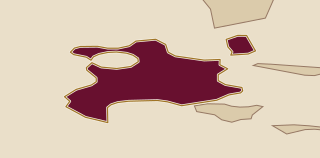
Paarl is a large Wine of Origin district in the Western Cape, roughly an hour northeast of Cape Town. The town sits in a broad valley floored by the Berg River; the vineyards that matter most climb the flanks of the mountain ranges on either side. Avondale occupies slopes facing the Klein Drakenstein range, high enough to catch cooler air off the mountains, oriented across the valley toward the Simonsberg.
The Paarl appellation allows a wide range of grape varieties, and the estate uses that latitude. The altitude and mountain exposure moderate what would otherwise be a warm inland valley climate, slowing ripening and preserving acidity. Those two facts show up in every bottle Avondale makes.
In the cellar
Vineyards and cellar
Every vine at Avondale is farmed organically and biodynamically, certified under both systems. Wild yeast fermentation is not a choice made vintage by vintage; it is fixed practice. The cellar is gravity-flow from intake to vessel, which removes the pump pressure that can break grape skins prematurely and push coarser phenolics into the juice. The one-hectare block vinification applies across all tiers of the range, from the entry Jonty's Ducks blend to the Qvevri Red.
For the Qvevri Red, 24 clay vessels, each between 800 and 1,000 litres, are buried in the cellar floor in the Georgian manner. The grape solids, skins, and juice ferment together in the clay for one to three months of skin contact. The wine then ages in the same vessels for twelve months before bottling. No oak is involved at any stage. The tannin in the finished wine comes entirely from skin and seed contact inside the clay; the clay itself contributes a faint mineral texture that no barrel programme would produce.
Wines to know
The range in view
The range runs across three tiers, each with a distinct production logic.
Jonty's Ducks Pekin Red is the entry-level blend: 37% Shiraz, 26% Cabernet Sauvignon, 24% Merlot, 5% Cabernet Franc, 4% Petit Verdot, and 4% Malbec. Six varieties, all vinified separately by one-hectare block, assembled after fermentation. The nose opens on blackcurrant, liquorice, dark chocolate, and ground coffee. Tannin is firm but approachable, and the acidity from the mountain aspect keeps the dark fruit from turning heavy.
A useful way in
A bottle to begin with
The Qvevri Red is the bottle to start with. Not because it is the most approachable but because it makes the estate's entire logic visible in one glass. The vessel is the production decision: 24 buried clay jars, one to three months of skin contact, twelve months of post-fermentation ageing in the same clay, and then bottling without oak contact. The 50% Grenache-dominant GSM blend produces lifted red fruit and violet aromatics, and the clay draws tannin from the skins rather than from barrel staves, so what you taste is grape and site, not wood. Buy this first, and everything else Avondale makes will make immediate sense.