
Why it matters
The producer
Domenico Settimo started farming an old stone property in Annunziata in 1943. His son Aurelio put the family name on a label in 1962 and named the Rocche dell'Annunziata cru, a named vineyard on the south-southwest-facing slopes above the hamlet. Aurelio died in 2007 and his daughter Tiziana took over management. Her son Davide joined in 2017 after studying oenology in Alba, making him the fourth generation to work this particular patch of Langhe hillside.
The scale stays small by choice. Six-point-six hectares, three wines, 40,000 bottles a year. Every Barolo the estate makes comes from the same cru its founder first farmed. The winemaking has not chased modern fashion: long fermentation on skins, large casks, slow development. That consistency is not inertia. It is a position.
Place and vineyards
Where the wines begin
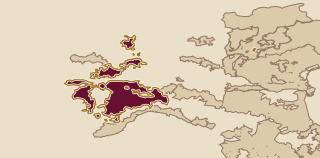
La Morra is one of the six communes that make up the Barolo zone in Piemonte's Langhe hills. It sits on the western edge of the appellation, and its soils tend toward limestone and clay with a softening influence on Nebbiolo compared to the sandier, more iron-rich soils of Serralunga d'Alba to the east.
The Rocche dell'Annunziata cru sits within La Morra's Frazione Annunziata at roughly 270 metres, oriented to the south-southwest between the San Martino and Cerequio-Brunate hills. That aspect gives the vineyard long afternoon sun while avoiding the heat accumulation of a direct south face. Barolos from here tend toward aromatic complexity alongside weight, which shows in the label: the estate's single-vineyard bottling carries the Rocche dell'Annunziata name on the front, a designation that connects the bottle to a specific slope.
In the cellar
Vineyards and cellar
Nebbiolo for Barolo ferments on skins for 15 to 20 days with a submerged cap and regular pump-overs. Submerged cap fermentation keeps the grape skins beneath the surface of the fermenting must, in contact with the juice throughout rather than floating above it. Pump-overs redistribute colour and tannin from the skins into the wine evenly. Together, these choices extract colour and tannin from Nebbiolo's thick skins: deep colour, firm tannin, the grip that Barolo needs to age.
Ageing happens in large oak casks of 2,500 to 3,500 litres. At that volume, oak surface area relative to wine volume is low, which means the casks provide slow oxygenation without imparting much oak flavour. The wine develops in the barrel through gradual air exposure rather than absorbing wood character from it. This is the traditional Barolo ageing logic: the wine should taste of Nebbiolo and Rocche dell'Annunziata, not of the vessel that held it.
Wines to know
The range in view
Three wines cover the entire range.
The Barolo DOCG is the estate blend, drawing from Nebbiolo parcels across the Rocche dell'Annunziata holdings. It is the entry point into the estate's Nebbiolo: a wine of considerable weight, firm tannin from the long maceration, and the aromatic complexity that south-southwest slopes consistently give the grape here. The acidity is firm and the finish long, with the kind of grip that softens over five to ten years in the bottle.
A useful way in
A bottle to begin with
Start with the Barolo Rocche dell'Annunziata. It is the wine that names the cru, works the cellar method hardest, and shows what this estate is building toward. The grape is Nebbiolo from south-southwest slopes at 270 metres. The fermentation ran the full 15 to 20 days on skins. The casks were large. Nothing was done to soften or accelerate the wine.