
Why it matters
The producer
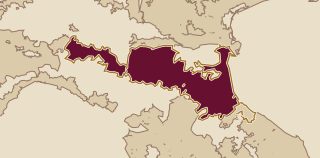
Francesco Torre runs Il Maiolo from Ponte dell'Olio, a village in the Val Nure valley above Piacenza in Emilia-Romagna. His partner Elena manages marketing. The estate covers around 10 hectares and produces roughly 25,000 bottles a year across three wines: two reds and one white. What sets Il Maiolo apart from almost every other producer in Piacenza is not the range or the scale but the pace. Reds spend approximately five years from harvest to sale. Native yeasts do all the fermentation work. Sulfur appears once, at bottling, at 2 grams per hectolitre.
Il Maiolo was the first certified organic winery in Piacenza province. The certification arrived in 1996, a full generation before most Italian estates gave organic farming serious commercial thought.
Place and vineyards
Where the wines begin
Ponte dell'Olio sits in the Val Nure, a long valley running south from Piacenza into the Apennine foothills of Emilia-Romagna. The Piacenza hills, known in Italian wine geography as the Colli Piacentini, carry a distinct local grape tradition. Barbera and Bonarda dominate the red wines. Ortrugo, a white grape almost unknown outside the province, anchors the whites.
The valley's altitude and limestone-rich soils push freshness into the reds and keep the whites from going flat. Il Maiolo's white parcel, Campo di Ponte, sits at 450 metres in the Travo municipality, high enough that the grapes retain a firm acid line even in a warm growing season. That altitude shapes what the Campo di Ponte delivers in the glass: a white wine with grip and aromatic complexity rather than the soft, quick-drinking style typical of lower-altitude Emilia production.
In the cellar
Vineyards and cellar
Il Maiolo uses no synthetic fertilizers and applies nothing in the vineyards beyond organic matter returned to the soil. The grassed rows reduce vigour and compel the vines toward deep root development rather than surface growth.
In the cellar, fermentation uses only the native yeasts present on the grape skins. No cultured yeasts are added. This commits the cellar to a longer, less predictable fermentation, but it allows the local microbiology of the Val Nure to remain inside the wine.
Wines to know
The range in view
Il Maiolo makes three wines.
Emilia Riserva is the flagship red, a four-grape blend of Barbera (60%), Bonarda (20%), Merlot (15%) and Cabernet Sauvignon (5%). Barbera brings high natural acidity and dark cherry fruit. Bonarda contributes soft tannin, a blueberry and plum character, and a slight earthy depth. Merlot rounds the mid-palate. Cabernet Sauvignon at five percent adds structural backbone without shifting the wine's regional character. The full five-year cycle from harvest to sale means this wine arrives in the glass with secondary complexity already in place: the fruit has deepened, the tannins have softened, and the oak has fully integrated.
A useful way in
A bottle to begin with
Start with the Emilia Riserva. It is the wine that carries all of Il Maiolo's decisions in a single bottle: the local grapes, the native yeast fermentation, the long barrel ageing, the minimal sulfur. The Barbera and Bonarda combination gives the wine high acidity and dark fruit with a dry earth note underneath, a profile that is distinctly Piacentine rather than borrowed from anywhere else in Italy. Because the wine arrives already five years from the harvest, it drinks with the kind of settled complexity already present after that period. There is no rough edge to wait out.