
Why it matters
The producer
The Bettili family has farmed the hills and lakeside plains of the Verona province since the early 1900s. Siro Bettili bought Tenuta Sorsei in Cavaion in 1965 and Tenuta Vignega in Pescantina twelve years later, acquiring eight hectares of old vines in the Valpolicella Classico zone. Both estates ran on conventional methods until 1999, when his daughter Cristiana joined the business and changed the direction completely.
Cristiana arrived with a clear aim: to make wines that respect the environment. Within a year, both estates were farming organically under BIOS certification, a commitment that has held for more than two decades. The estate now carries her name and her agenda. In 2019, the Italian Ministry of Agriculture awarded the estate VIVA environmental certification, a programme that measures the sustainability of wine production across air, water, land, and landscape.
Place and vineyards
Where the wines begin
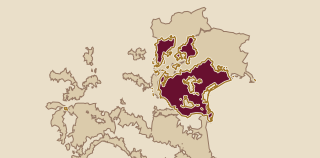
Tenuta Vignega sits at 140 metres above sea level in Pescantina, a hillside commune on the western edge of the Valpolicella Classico zone. Valpolicella Classico is the historic inner core of the appellation, a band of hills running northwest of Verona where Corvina, Corvinone, and Rondinella have grown for centuries. The elevation and the gravelly limestone bedrock drain freely between rains while holding enough moisture through dry spells to keep old vines stable. That soil type pulls the wines toward an austere, mineral character rather than soft, fruit-forward extraction.
Tenuta Sorsei lies in Cavaion, on the hinterland of Lake Garda, well within the Bardolino DOC zone. Bardolino is a lighter appellation than Valpolicella, shaped by the moderating influence of the lake: cooler nights, gentler sun exposure, and soils that favour pale, fresh reds and rosé over weight and tannic grip. The two estates therefore pull in opposite directions, and the range reflects that geography directly.
In the cellar
Vineyards and cellar
Tenuta Vignega's eight hectares of old vines in Pescantina form the backbone of the Valpolicella wines. Old vines in the Classico zone carry lower natural yields than younger plantings; the fruit from each cluster is more concentrated, and the tannins have time to develop fully rather than arriving green and harsh. Organic farming without synthetic herbicides or pesticides encourages a more active soil biology, which translates into roots that go deeper and vines that manage water stress on their own terms.
Wines to know
The range in view
The estate produces across two appellations from two tenute, and the range divides clearly by geography.
From Tenuta Vignega come the Valpolicella Classico-zone wines. The Ripasso Superiore is the most developed bottle in the range, blending Corvina (60%), Corvinone (15%), Rondinella (15%), Cabernet Sauvignon (6%), and Oseleta (4%). The blend is unusual in including Cabernet Sauvignon and the rare Oseleta alongside the Classico trio. Cabernet adds a structural backbone and dark-fruit depth; Oseleta contributes colour and tannin grip. The twelve months of oak ageing rounds the tannins and deepens the dried-fruit notes. Alongside the Ripasso, Tenuta Vignega produces Valpolicella Classico wines that carry the estate's hallmark character: dry, austere, long on the finish, with cherry at the centre and notes of chocolate and vanilla.
A useful way in
A bottle to begin with
The Valpolicella Ripasso Superiore is the bottle to start with. It is a Corvina-dominant blend from old vines grown on gravelly limestone at 140 metres in Pescantina, passed over Amarone pomace after fermentation and aged for twelve months in oak. The result sits between the freshness of a straight Valpolicella Classico and the weight of a full Amarone: ripe cherry and blackberry on the nose, chocolate and vanilla from the oak, juicy cherry on the palate, thin and approachable tannins, and a finish that lasts. It is organic across all fruit.