
Why it matters
The producer
Bocale is a family estate in Montefalco, a hill town in the heart of Umbria whose name sits on some of Italy's most tannic red wines. Valentino Valentini runs the estate with his brother and their parents. The Valentini family has been rooted in Montefalco for more than a century; the formal winery came later, in 2002, when they committed to estate bottling under their own name rather than selling grapes or bulk wine to others.
The name Bocale is the family's own nickname. In the local dialect, bocale is a two-liter clay or glass pitcher used to carry wine or olive oil between houses. The word followed them onto the label, and it sits on every bottle they produce.
Place and vineyards
Where the wines begin
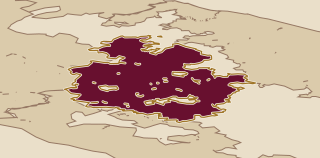
Montefalco sits in central Umbria, southeast of Perugia, on a ridge above the Spoleto valley. The hill town is surrounded by its own vineyards. Sagrantino, an ancient red variety indigenous to this cluster of hills and essentially unknown outside it, earned its own DOCG appellation here: Montefalco Sagrantino DOCG, a classification that exists for dry Sagrantino and for the traditional passito version made from partially dried grapes.
Below the DOCG, Montefalco Rosso DOC covers a Sangiovese-led blend that can include Sagrantino and other permitted varieties. The Spoleto DOC, which extends into the valley below, covers Trebbiano Spoletino, a white grape native to this corridor.
In the cellar
Vineyards and cellar
In the vineyard, Bocale uses organic and mineral fertilizers and excludes all herbicides and synthetic chemicals. Natural grass regeneration keeps cover crops in the vine rows, which controls erosion and promotes soil life without mechanical tillage.
In the cellar, fermentations run exclusively on native yeasts: no added commercial strains. The wines age in French oak barrels. Nothing is filtered, microfiltered, or thermally stabilized before bottling. Sediment forms in the bottle over time; decanting before serving is recommended.
Wines to know
The range in view
The range has five bottles and two core styles: red wines built on Sagrantino and Sangiovese, and a single white from Trebbiano Spoletino.
Montefalco Sagrantino DOCG is the dry red. Sagrantino is an extraordinarily tannic grape: dense, dark-fruited, with a bitter cherry character and a tannin grip that takes years to resolve. Bocale's version spends time in French oak and leaves the cellar unfiltered. It is not an easy young wine. Given time, the tannins integrate and the dark fruit opens.
A useful way in
A bottle to begin with
Start with the Montefalco Sagrantino DOCG, the dry version. It is the grape Montefalco exists for, the wine that earns the DOCG, and the clearest demonstration of what Bocale does in the cellar: native yeasts, French oak, no filtration, no stabilization. On the nose, blackberries and blackcurrant, vanilla from oak. On the palate, bitter cherry and firm, grippy tannin. The finish is long and dry. Decant it well before serving. It will not give everything immediately, but what it gives is specific to this hill, this grape, and this family's way of working.