
Why it matters
The producer
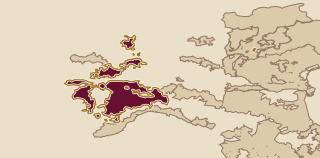
Bric Cenciurio sits on both sides of the Tanaro River in Piemonte, with Barolo vineyards on the Langhe bank and Arneis parcels in the sandy Roero hills to the northwest. The estate takes its name from an ancient vineyard in Roero called Bric Cenciurio. The 18 hectares spread across four communes, Barolo, Novello, Castellinaldo, and Magliano Alfieri, covering the Nebbiolo-dominated Langhe and the lighter, aromatic hills across the river.
Franco Pittatore and his brother-in-law Carlo Sacchetto founded the estate in 1990 by merging their separate family properties. Franco died in the vineyard roughly two years later, leaving his sons Alessandro and Alberto still young. Carlo and Franco's widow Fiorella kept the estate running until the sons were ready. Alessandro and Alberto now manage the winery alongside their mother and uncle. That second-generation inheritance shapes everything about how the estate works: manual labor throughout, sustainable farming, a range that covers both territories their father and uncle chose to join.
Place and vineyards
Where the wines begin
The Tanaro River divides Piemonte into two distinct agricultural territories at this point. On the southeast bank lie the Langhe hills, where Nebbiolo produces Barolo, one of Italy's most age-capable red wines. On the northwest bank lie the Roero hills, geologically older, with sandier, fossil-rich soils and a reputation for Arneis, the white grape that was almost extinct by the 1970s before a handful of Roero producers revived it.
Bric Cenciurio works both sides. The Barolo parcels, on the right bank of the Tanaro in the Monrobiolo di Bussia area, include vines over 40 years old. The Arneis parcels sit in Castellinaldo in Roero. The Barbera d'Alba vines are in Magliano Alfieri, another Roero commune. The estate's geographic spread means that the Barolo label and the Arneis label come from different soils, different climates at the micro level, and different grape varieties responding to different ground. The range architecture follows the river.
In the cellar
Vineyards and cellar
Farming is strictly manual across all four communes. No mechanical harvesting, no shortcuts through canopy management. The estate cites biodiversity as a formal commitment: the vineyards are managed to support the broader agricultural ecosystem around the vines, not just the vine rows.
The Arneis production sequence is the most technically distinctive in the range. Grapes are harvested in early September and immediately go into cold storage at zero degrees Celsius for 15 days. The purpose is direct: the cold concentrates aromatic compounds in the juice before any fermentation begins. After cold storage, fermentation runs at low temperature in stainless steel, preserving the primary floral and stone-fruit aromatics that make Arneis legible in the glass. The Sito dei Fossili cuvee then moves to large oak barrels of 2,000 to 3,500 liters for six months. Barrels of this size add texture and gentle oxygen contact without imposing oak flavor, so the wine gains weight while the aromatics stay intact.
Wines to know
The range in view
The range covers three appellations and two distinct territories.
Barolo DOCG Monrobiolo di Bussia is Nebbiolo from parcels with vines over 40 years old on the right bank of the Tanaro. The Monrobiolo di Bussia area sits within the Bussia subzone of Barolo, known for wines with dried rose, tar, and firm tannin. The 24-month oak program and additional bottle aging produce a wine that is angular and demanding when young, with the structural depth to reward several years of cellaring. The fruit is dark cherry and dried plum; the tannin is drying and gripping; the finish is long and mineral.
A useful way in
A bottle to begin with
Start with the Roero Arneis Sito dei Fossili. It is an Arneis from Castellinaldo parcels in the Roero hills, fermented cold in stainless steel and then aged six months in large oak, and it demonstrates the most deliberate and distinctive production choices on the estate. The nose is immediately generous: white peach, pear blossom, a faint note of almond. In the mouth the large-barrel aging has built genuine texture, a mid-palate roundness that many Arneis wines lack, while the acidity holds the finish clean. It is not an anonymous white wine.