
Why it matters
The producer
Buffon is a family estate in Castello Roganzuolo, a small village on the edge of Conegliano in the Alta Marca Trevigiana, the hill country of northeastern Veneto where the land climbs into the Dolomite foothills and the Glera grape has been cultivated for generations. Brothers Quirino and Cleris Buffon handle every production phase personally: vine cultivation, harvest, vinification, and bottling, without delegating to outside contractors or a hired cellar team. At 150,000 bottles per year, that degree of direct involvement is a deliberate operating model, not a small-grower default.
The estate appears under two names. The formal legal entity is Azienda Agricola Buffon. The regional Prosecco Consorzio lists it as Buffon Giorgio, a commercial designation derived from the family name. Both refer to the same property, the same vines, and the same two brothers.
Place and vineyards
Where the wines begin
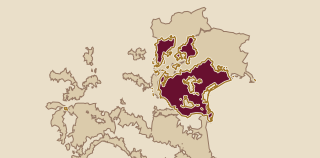
Castello Roganzuolo sits near Conegliano, the eastern anchor of the Prosecco Superiore Conegliano Valdobbiadene DOCG, a denomination that runs west through the hills to Valdobbiadene across a corridor of steep, terraced, glacially sculpted terrain. The Alta Marca Trevigiana is the broader cultural and geographic zone that contains this hill country: elevated, cooler than the Venetian plain below, and shaped by morainic soils left by retreating glaciers.
The DOCG designation matters on the label because it signals hillside Glera grown within a legally bounded zone of higher-altitude parcels, as distinct from Prosecco DOC Treviso, which draws from flatter land across the wider Treviso province. Buffon makes wines in both tiers. The DOCG bottles carry the Conegliano Valdobbiadene name on the front label; the DOC Treviso bottles do not. That distinction is the first thing to check when navigating the range.
In the cellar
Vineyards and cellar
The Buffons farm their own vineyards in Castello Roganzuolo, working through the full growing season and conducting their own harvest rather than buying in fruit. The moraine hill position provides drainage and sun exposure. No details on specific training systems, vine age, or cellar equipment are available from current verified sources. What is documented is the brothers' hands-on management of cultivation, harvest, vinification, and bottling as a continuous and undivided process.
Wines to know
The range in view
The range divides into two clear tiers and two broad categories.
At the top, Prosecco Superiore Conegliano Valdobbiadene DOCG comes in Brut and Extra Dry styles, both from Glera grown in the DOCG hill zone. Brut carries less residual sugar, typically under 12 grams per litre, and finishes drier, with the apple and pear fruit of Glera offset by a more pronounced acidity. Extra Dry sits just above Brut on the sweetness scale, between 12 and 17 grams per litre, which softens the finish and adds a slight floral lift. Both styles are produced by the Charmat method, with secondary fermentation in pressurised tanks to build mousse and preserve Glera's fresh fruit character.