
Why it matters
The producer
Beppe Caviola made his first wine in a rented vineyard. In 1991 he was farming the Barturot parcel in Montelupo Albese, a small village in the Langhe hills of Piemonte, when Elio Altare tasted his Dolcetto and told him to bottle it. Caviola put his name on the label, produced 860 bottles, and Ca'Viola existed. That opening move captures something permanent about the estate: a producer who earns his decisions, learns by doing, and takes the grapes seriously before the prestige.
Calculating by instinct, Caviola built a parallel consulting practice while tending his own vines, eventually advising more than thirty wineries across Italy. The trade called him The Flying Winemaker. He moved the estate to Villa Bracco, a large 19th-century villa in Dogliani, in 2002, giving Ca'Viola a permanent home in the Dolcetto country at the southern edge of the Langhe. Three years later he added Barolo to the portfolio, sourcing Nebbiolo from the Sottocastello di Novello area in the commune of Novello. Ca'Viola now farms roughly 12 hectares and produces five wines across three grapes.
Place and vineyards
Where the wines begin
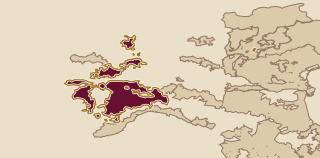
Montelupo Albese, where Ca'Viola keeps its Barbera and Dolcetto parcels, sits in the Langhe, the amphitheatre of hills south of Alba that produces most of Piemonte's serious red wine. The Langhe appellation covers a broad sweep of country; the Barolo DOCG zone, a tighter legal designation centred on eleven communes, lies to the west and south. Dogliani, where the cellar now sits, is the heartland of Dolcetto di Dogliani and a natural base for working across both Montelupo Albese and the Barolo zone.
The Sottocastello di Novello area, from which Ca'Viola draws Nebbiolo for its Barolo, falls within the Barolo DOCG in the commune of Novello, on the southwestern edge of the appellation. Novello's vineyards tend toward altitude and exposed positions. The multi-vineyard Caviòt Barolo draws from several parcels across the Barolo zone, blending differing soils, exposures, and altitudes into a single wine.
In the cellar
Vineyards and cellar
All Ca'Viola vineyard work in Montelupo Albese is certified organic. Bric du Luv Barbera comes from the 1.5-hectare old-vine parcel and is fermented for 20 to 25 days in temperature-controlled tanks, a longer maceration than most Barbera, which extracts more colour and builds a fuller mid-palate. After fermentation, the wine goes into 10-hectolitre casks, a medium format that adds gentle wood character without masking fruit, and ages for 13 to 15 months before bottling unfiltered. Skipping filtration preserves the texture and the fine suspended material that contributes to how the wine develops over eight to ten years.
Brichet, sourced from the 2.4-hectare organic parcel in Montelupo Albese, is fermented for 15 to 18 days with brief barrel ageing, targeting freshness over weight.
Wines to know
The range in view
The Ca'Viola range runs from two Langhe entry bottles to an old-vine Barbera and a Barolo tier.
Brichet Dolcetto comes from the 2.4-hectare organic Montelupo Albese parcel, fermented 15 to 18 days, with brief barrel time. The colour is deep ruby with purplish tones; the nose offers red fruits, underbrush, and sweet spice; the palate is fresh and medium-bodied, with the soft, low-acid character typical of Dolcetto.
A useful way in
A bottle to begin with
Start with Bric du Luv. It is 100% Barbera from 1.5 hectares of 65-year-old organic vines in Montelupo Albese, fermented 20 to 25 days, aged 13 to 15 months in 10-hectolitre casks, and bottled without filtration. In the glass it shows what old-vine Barbera on calcareous soil can do when farmed organically and given proper cellar time: the fruit is ripe and concentrated, the balsamic and menthol notes are surprising on first encounter, and the acid backbone carries the wine across eight to ten years without the tannin weight found in young Barolo.