
Why it matters
The producer
Franco D'Eusanio was an agronomist before he was a winemaker, and that sequence matters. When he acquired land outside the village of Nocciano in Pescara Province in 1991, his instinct was to read the ground before filling the cellar. He farmed the 60 hectares organically from the start, not as a later certification project but as the original position of someone trained to understand soil before yield. The first wine did not leave the estate until 1996, five years after the vines went in.
Three decades on, Franco leads the estate alongside his children Ilaria and Rocco. The wines sell to 25 countries. The flagship is Perla Nera, a 100% Montepulciano aged 18 months in barriques. The family calls the founding orientation Vinosophia, a phrase they use to connect the agronomist's original logic to the bottles they make today.
Place and vineyards
Where the wines begin
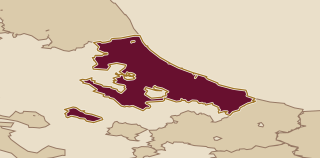
Nocciano sits in the hilly country of Pescara Province, in the part of Abruzzo where the land rises between the Pescara and Nora river valleys. The terrain is rolling and elevated enough to cool the growing season, which is why Montepulciano, a grape that can turn thick and overripe on flat, hot ground, retains acidity and aromatic lift here. The hills channel air movement, and the two river corridors mark the lower boundaries of the estate's planting zone. Abruzzo as a region runs from the Apennine spine down to the Adriatic coast; Nocciano is in the interior, away from the coastal plain where temperatures are higher and Montepulciano tends toward a heavier, more extracted style.
In the cellar
Vineyards and cellar
The 60 hectares are farmed organically, with the estate working toward formal European Organic and AIAB Guarantee certification. Organic viticulture in a warm continental climate like inland Abruzzo requires careful canopy management to prevent disease pressure; the commitment to it across 60 hectares is a logistical choice as much as a philosophical one, and it shapes the fruit character of the wines: cleaner skins, less residual chemical influence, and a tendency toward natural acidity rather than corrected freshness.
In the cellar, Perla Nera receives 18 months in barriques followed by 6 months in bottle before release. That ageing programme integrates oak into the wine's fruit over time, softening the Montepulciano tannins and adding the chocolate and spice character the grape absorbs well from new wood. The entry-level Montepulciano and the Pinot Grigio are handled more simply.
Wines to know
The range in view
The range at Chiusa Grande is straightforward in its architecture. Montepulciano is the primary grape and the range's backbone. The entry-level Montepulciano is built for early drinking: intense, fruity, with maraschino cherry on the nose and a spicy mid-palate of liquorice and vanilla that sits alongside a balanced, rounded body and good length. It is a direct expression of the grape with no heavy cellar intervention.
The Pinot Grigio moves in a different direction. The nose is aromatic and fresh, with pear and green apple leading, then acacia flower and honeycomb softening the fruit. It is a wine for the table rather than for ageing, broad and textured rather than sharp and mineral.
A useful way in
A bottle to begin with
Perla Nera is the bottle to open first. It is 100% Montepulciano from the Nocciano parcels, aged 18 months in barriques and 6 months in bottle before release. In the glass it shows ripe dark fruit, chocolate, and black pepper on the nose, then soft, well-integrated tannins and a long, spiced finish. The oak is present and deliberate but does not override the grape. It shows what an agronomist's patience produces: a wine that could have been released years earlier and wasn't, because the vineyard and the cellar programme both needed time to arrive at this weight and coherence.