
Why it matters
The producer
When Chiara Ciavolich took over the family estate in 2004 at twenty-six, she left a law degree behind and inherited a winery that had already survived wool merchants, wars, and centuries of Abruzzese hill farming. The estate had been in the family since around 1560 and formally established as a working winery in 1853. What she inherited was a physical anchor: old underground cellars in Miglianico, parcels split between the hill towns of Loreto Aprutino and Pianella in the province of Pescara, and a range built on the native grapes that Abruzzo has grown for generations.
The grapes at the centre are Montepulciano and Trebbiano d'Abruzzo, with Pecorino, Passerina, and Cococciola also in the ground. Chiara and her husband Gianluca farm 35 to 40 hectares across the two sites and produce around 200,000 bottles annually. The production philosophy is direct: keep alcohol moderate, let native variety character carry the wine, and choose the fermentation vessel by what each grape needs rather than by formula.
Place and vineyards
Where the wines begin
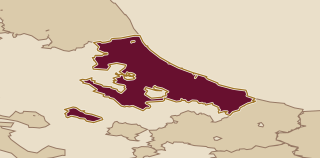
Abruzzo runs down the central spine of Italy, where the Apennines drop toward the Adriatic coast. The province of Pescara sits in the middle of that corridor, and the hill towns of Loreto Aprutino and Pianella are inland farming country at moderate altitude, with warm summers tempered by mountain air and cooler nights that slow ripening and hold acidity in the grapes.
The Pianella parcels planted to Montepulciano have an unusual local advantage: proximity to a natural lake whose water table keeps vine roots moist through dry summer months. Vines under heat stress concentrate sugar at the cost of aromatic freshness. The lake moisture holds that stress back, so the Pianella Montepulciano ripens more evenly and holds the red-fruit character the grape carries when it is not pushed too hard by drought.
In the cellar
Vineyards and cellar
The older parcels run on pergola abruzzese, the traditional Abruzzese vine training system that spreads the canopy horizontally over a frame, keeping grapes shaded and slowing ripening. Newer parcels use guyot, which concentrates the vine's output into fewer, better-defined clusters.
In the cellar, the vessel changes by wine. The entry Montepulciano d'Abruzzo is fermented in temperature-controlled stainless steel with a single délestage, a pump-over technique that breaks up the cap of skins gently rather than extracting aggressively, then aged almost a year in stainless steel and six months in bottle. The approach keeps the wine fresh and the tannin firm without adding oak weight.
Wines to know
The range in view
The range is built around four main wines, moving from approachable stainless-aged reds to amphora-fermented whites and an old-vine reserve tier.
The entry Montepulciano d'Abruzzo at 13.5% is the largest-volume wine. It is soft-bodied with firm tannin and red-fruit character, built for early drinking but with enough grip to hold for a few years. The single délestage keeps the extraction light.
A useful way in
A bottle to begin with
Start with the Aries Pecorino. Pecorino is a native Abruzzese white grape, high in natural acidity and distinctively aromatic, and this bottle shows what the estate does with it at its most focused: hand-harvested fruit, cold stainless fermentation to hold the grape's freshness, three months in French oak tonneaux to add just enough body, bottled at 12.5%. This white wine has real texture, mouth-watering acidity, a slightly waxy mid-palate, and a clean herbal finish. At 12.5% it is light enough to stay lively through a full meal. It is also the clearest illustration of Chiara's core philosophy: native grapes, moderate alcohol, a single precise cellar decision.