
Why it matters
The producer
Francesco Cirelli came from a business administration background in northern Italy and returned to his Abruzzo homeland to work with the land. He founded an organic farm where vineyards grow beside grains, fruit trees and olive trees, while animals roam the property. The aim is complete agricultural coexistence, with wine made within the same farming system.
Amphora is part of Cirelli's cellar work, and Cirelli received biodynamic certification in 2021. The Montepulciano d'Abruzzo and Trebbiano d'Abruzzo wines leave the cellar without fining or filtration.
Place and vineyards
Where the wines begin
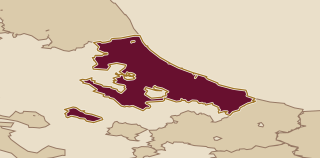
Near Atri in Teramo province, the farm sits approximately 8 kilometers from the Adriatic Sea and 250 meters above sea level in the Colline Teramane region, close to the Riserva Naturale Calanchi di Atri. That setting puts the vineyards above the coast. Wines from this setting show bright acidity, and their names join grape to place in Montepulciano d'Abruzzo and Trebbiano d'Abruzzo.
Wines to know
The range in view
The range includes a Montepulciano d'Abruzzo red and a Trebbiano d'Abruzzo white. Montepulciano d'Abruzzo 2023 is destemmed, fermented spontaneously with indigenous yeasts and aged for 6 months in stainless steel. The inert steel adds no oak flavour. The bottle is unfined and unfiltered, with minimal sulfites. Tart cherry and blackberry meet wooly tannins in a thick textured mouthfeel.
Trebbiano d'Abruzzo 2024 is made from whole bunches gently pressed intact, then the juice ferments spontaneously with indigenous yeasts in stainless steel tanks without temperature control. It rests on fine lees for 4 months before bottling without fining or filtration. Fine lees contact adds texture to the white wine before bottling. The nose brings peach pit, green apple, raw almond, delicate white flowers and a whisper of chamomile. On the palate, ripe pear and quince meet saline minerality.