
Why it matters
The producer
The Contucci family has been cultivating grapes in Montepulciano since the 11th century, making them one of the oldest documented wine-growing families in the appellation. Their cellars run beneath a 16th-century mansion at the heart of the hilltop town, cut into the stone of what were once the town's medieval defensive walls. The winery occupies space that was originally military architecture, and that physical continuity with Montepulciano's medieval past shapes everything about the estate: the scale, the traditional approach in the cellar, and the commitment to growing nothing but the varieties that belong here.
The estate covers 170 hectares, with 21 under vine, of which 15 are planted to produce Vino Nobile. Output runs to approximately 100,000 bottles annually across the two wines in the range.
Place and vineyards
Where the wines begin
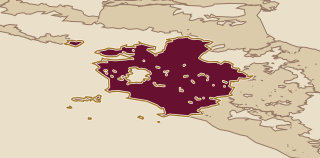
Montepulciano is a hill town in the province of Siena in southern Tuscany, and it gives its name to two appellations that share the same vineyards and grapes but sit at different levels of the wine-law hierarchy. Vino Nobile di Montepulciano DOCG is the estate's main wine: a red wine built on Prugnolo Gentile, the local name for a Sangiovese clone long grown in this part of Tuscany. The rules require a minimum of 70% Prugnolo Gentile, and Contucci runs their 2020 at 80%, blended with Colorino and Mammolo. Rosso di Montepulciano DOC is the appellation's second tier: lighter, earlier-drinking, and in Contucci's case aged in stainless steel rather than oak, giving it a brighter, more immediately accessible character than its elder sibling.
The vineyards sit at altitude, which slows ripening and holds acidity into the fruit. That acidity is what gives Prugnolo Gentile its frame and its ability to carry several years of ageing without losing freshness.
In the cellar
Vineyards and cellar
Contucci grows no international varieties. Every vine on the estate is a traditional Tuscan grape: Prugnolo Gentile, Canaiolo Nero, Mammolo, Colorino, Trebbiano Toscano, Malvasìa del Chianti, and Grechetto. The estate's vineyards contain only these local varieties.
In the cellar, the Vino Nobile is aged two years in large oak botti ranging from 9 to 25 hectoliters, racked twice each year, then moved to concrete tank before bottle maturation. Large botti impart far less flavour than smaller barrique casks. The oak's job here is slow oxygen exchange, which softens tannin and allows the wine's dark fruit and earthy notes to develop without acquiring the vanilla or toast character that smaller barrels introduce. The Rosso di Montepulciano bypasses oak entirely: fermented and aged in stainless steel, it preserves primary fruit and goes to bottle earlier.
Wines to know
The range in view
The Rosso di Montepulciano 2023 is 80% Prugnolo Gentile, 15% Canaiolo Nero, and 5% Colorino from a single vineyard near Pieve Sant'Albino in the south of the appellation. Entirely stainless steel, it carries bright red fruit, light tannin, and the kind of direct acidity. It is not a simplified version of the Vino Nobile; it is a different wine, built for earlier drinking and a fresher register.
The Vino Nobile di Montepulciano 2020 is the main event: 80% Prugnolo Gentile with Colorino and Mammolo from three mature vineyard sites across different parts of the appellation. Two years in large oak botti, two rackings per year, then concrete and bottle. The wine arrives with a fuller body than the Rosso, a tannic frame that has been softened but not dissolved by the oak, and the classic Prugnolo Gentile character of dark cherry, dried tobacco, leather, and underbrush. Good balance at medium-plus weight, with the acidity to develop over several more years.