
Why it matters
The producer
Demarie farms the sandy north bank of the Tanaro river, where the Roero DOCG sits geologically apart from the clay-heavy Langhe on the opposite shore. Brothers Aldo and Paolo Demarie, together with Paolo's wife Monica, run an estate that now spans approximately 30 hectares and produces around 120,000 bottles a year across ten wines. Third-generation ownership has not narrowed the range; it has spread it from the white Arneis and lightly sparkling Birbet of the Roero home ground through to Barbaresco and Barolo from Langhe Nebbiolo.
The wine that most clearly marks Demarie's own direction is not a red. The Roero Arneis Spumante is made by the traditional method, the same process used in Champagne, with a minimum of 18 months ageing on lees. Arneis is almost never vinified this way in the Roero. Choosing to do so says something about how the family reads the grape: as something with enough body and aromatic complexity to hold up through secondary fermentation and a long lees contact.
Place and vineyards
Where the wines begin
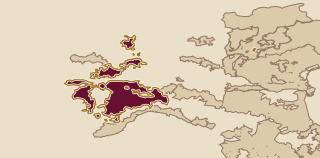
The Roero occupies the left bank of the Tanaro, the river that also forms the northern boundary of the Langhe. The two zones are close in distance and far apart in geology. The Roero's soils are predominantly sandy, mixed with marine sediments, seashells, and limestone laid down when this part of Piemonte was still submerged. That sandy, free-draining base lightens everything grown here: whites from Arneis tend toward floral and fresh rather than weighty, and reds from Nebbiolo in Roero ripen earlier and with softer tannin than their counterparts across the river in Barolo and Barbaresco.
Demarie's vineyards spread across four communes: Vezza d'Alba, Castagnito, Castellinaldo, and Guarene. Each sits within the sandy Roero topography, with vineyards in all four communes.
In the cellar
Vineyards and cellar
The 30 hectares spread across four communes allow Demarie to work with the Roero's range of exposures and sand compositions rather than farming a single block. Arneis, the white grape native to the Roero, is planted across these parcels and vinified in two styles: still and sparkling. The still Roero Arneis follows the appellation's conventional path. The Spumante takes Arneis through secondary fermentation in bottle, then leaves the wine on the spent yeast cells for at least 18 months before disgorgement. That extended lees contact adds a bread-crust, toasty layer to the grape's natural pear and white flower character and softens the finish.
Nebbiolo grown in the Roero produces the Roero Riserva. The same grape, sourced from Langhe sites rather than Roero parcels, goes into the Nebbiolo d'Alba, Barbaresco, and Barolo. The cellar thus handles Nebbiolo across multiple appellation frameworks and soil types, adjusting winemaking to the different tannin and ripeness profiles each site delivers. Barbera d'Alba, Dolcetto d'Alba, Moscato d'Asti, and Birbet fill the remainder of the ten-wine portfolio.
Wines to know
The range in view
The ten wines divide into three clear groups. The Roero home wines are Roero Arneis, Roero Arneis Spumante, Roero Riserva, and Birbet. Birbet is a lightly sparkling, low-alcohol red made from Brachetto, a grape that produces wines with vivid strawberry and rose aromas and very little tannin. The Langhe reds are Barbera d'Alba, Dolcetto d'Alba, Nebbiolo d'Alba, Barbaresco, and Barolo. Moscato d'Asti, the naturally sweet, gently fizzy white from Moscato Bianco, sits at the lighter end of the portfolio.
The Roero Arneis rises from the glass with white peach, pear, and acacia blossom. In the mouth the wine is light-bodied and dry, with clean acidity cutting through the floral character and a short, fresh finish. The Arneis Spumante carries the same fruit base but builds on it: 18 months on lees add a faint autolytic quality, bread-crust and almond alongside the pear and flower, and the mousse is fine and persistent. The finish is drier and longer than the still version.
A useful way in
A bottle to begin with
The Roero Arneis is the clearest first bottle. It is a dry white wine made from Arneis, the grape native to the Roero DOCG, grown on the estate's sandy parcels in Vezza d'Alba and the surrounding communes. In the glass it is light, floral, and fresh: white peach and pear on the nose, a clean dry palate with enough acidity to give it shape, and a short, undemanding finish. It does not require food, though it pairs easily with seafood and lighter antipasti. A bottle of the Roero Arneis explains where the estate is, what the sandy Roero soils produce, and how Arneis behaves when farmed on its home ground.