
Why it matters
The producer
The Franchetto family has farmed the hillsides of Terrossa di Roncà since around 1800. For most of that time, their grapes left the estate in bulk, feeding the supply chain of other producers. In 1982, Antonio Franchetto was twenty years old. He pressed the harvest himself, made his own wine, and put the family name on the bottle. That decision ended 180 years of anonymity and started a winery.
Today four family members lead the estate: Antonio, his wife Mara, and their daughters Giulia and Anna. Giulia now carries the winemaking work, with an approach built on minimal intervention and close attention to the volcanic parcels her great-grandparents planted. All four are musicians, and it would not surprise a visitor to find a guitar leaning against a barrel in the cellar.
Place and vineyards
Where the wines begin
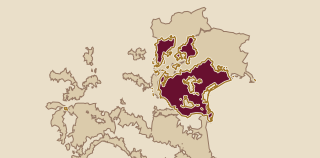
Terrossa di Roncà sits in the Val d'Alpone, a valley running through the eastern Lessini Mountains in Verona province. Roncà is one of several communes that make up the extended Soave DOC zone, the appellation that covers a broad arc of Veneto hillside from the historic Classico heart near the town of Soave eastward into volcanic territory.
The eastern communes, including Roncà, sit on basaltic lava and compressed seabed sediment from a period of volcanic activity roughly 45 million years ago. That geology separates the Val d'Alpone from the limestone and clay of the Classico zone. On basalt, Garganega tends toward sharper mineral expression, with flint and citrus notes that are harder to find on heavier soils. The volcanic origin is not a marketing flourish; it is measurable in the glass.
In the cellar
Vineyards and cellar
Garganega is hand-picked from the Terrossa parcels in mid-September and fermented under temperature control in stainless steel. No oak touches the wine at any stage. Temperature control during fermentation preserves the delicate floral and citrus character that Garganega expresses on volcanic soil; oak would cover it. The result at 12.5% alcohol is a light, mineral-framed white with enough freshness to drink young and enough definition to reward a year or two in bottle.
At Vestenanova, Durella is grown at altitude. The grape produces high acidity naturally and is well suited to the colder mountain conditions of the upper valley. At Vestenanova, Durella gives the estate a high-acid grape suited to the upper valley’s colder conditions.
Wines to know
The range in view
La Capelina is the estate’s primary white. It is 100% Garganega from the Terrossa parcels, made under the Soave DOC appellation. The nose is mineral and floral: flint, citrus blossom, and elderflower come up first from the glass. The palate adds cedar and apricot alongside the elderflower, with bright, clean acidity that keeps the wine from feeling soft or short. At 12.5%, the alcohol is low enough that the fruit drives the impression rather than warmth.
The estate also produces from Durella at the Vestenanova mountain vineyard, a high-acid indigenous grape suited to altitude. Pinot Grigio appears in the range as well. Both sit alongside La Capelina in the portfolio without displacing it as the estate's clearest statement.
A useful way in
A bottle to begin with
La Capelina Soave DOC is the right first bottle. It is 100% Garganega, fermented in stainless steel with no oak, at 12.5% alcohol, from volcanic basalt parcels in Terrossa di Roncà. The wine is mineral, light, and floral: flint on the nose, apricot and elderflower on the palate, bright acidity carrying through to a clean finish. Nothing about the bottle asks for food or occasion; it explains clearly what Garganega does on volcanic soil and what the family's unoaked, low-intervention approach produces in practice. Start here.