
Why it matters
The producer
Frank Cornelissen arrived on the slopes of Mount Etna in 2000 with no winery and no vines, just a conviction that the most interesting thing he could do with a career in wine was grow it rather than trade it. He had spent years as a Belgian merchant working with exceptional bottles before concluding that the volcano was where he wanted to be. One year after arriving he formally registered the estate.
That gap matters. Cornelissen farmed the mountain for a full year before he committed to the name, and the name he chose was his own, which is unusual on Etna where most producers anchor their name to a place. The winery sits on the northeastern flank of the volcano with 24 hectares under vine: 13 hectares of old alberello parcels, the traditional free-standing bush-vine system that has shaped Etna farming for centuries, and 9 hectares of old vines retrained into modern rows. He makes red and white wine from indigenous Sicilian varieties under a philosophy that rejects chemical, organic, and biodynamic treatments alike.
Place and vineyards
Where the wines begin
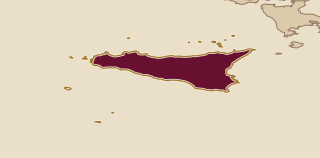
Mount Etna is an active volcano on the northeastern coast of Sicily. The northeastern flank where Cornelissen farms sits at elevations between 600 and 1,000 metres, high enough to cool what would otherwise be a hot Mediterranean growing season significantly. That cooling stretches ripening across months and pushes harvest to mid-October or early November, late by Sicilian standards and late enough that Cornelissen can wait for phenolic ripeness without the grapes baking in summer heat.
The elevation shapes the wines directly. Nerello Mascalese grown at altitude on volcanic soils keeps acidity that the same grape loses on lower, warmer ground. The longer growing season builds flavour complexity without surrendering freshness. Wines from this part of Etna tend toward pale colour, firm acidity, and lifted aromatics, qualities that come from the altitude and the volcanic mineral character of the soils rather than from cellar intervention.
In the cellar
Vineyards and cellar
The alberello parcels are farmed without machines. The low bush-vine form on steep volcanic slopes makes mechanical harvesting impossible, so every vine is handled individually. The harvest decision follows phenolic ripeness rather than a calendar date, which is why picking runs across several weeks in multiple passes. At 300 to 600 grams per vine, the top vineyard yields are a fraction of what conventional viticulture targets.
In the cellar, Susucaru Rosso is fermented with a pied de cuve, a small quantity of actively fermenting juice used to start spontaneous fermentation in the main tank. After that starter takes hold, fermentation and skin maceration continue together in fiberglass for approximately two months. The long skin contact extracts colour, tannin, and the aromatic compounds from the grape skins. No oak is used. No additives enter the wine at any stage. Susucaru Rosso has character from the grapes and the volcanic soils rather than from cellar flavour additions.
Wines to know
The range in view
Cornelissen's range runs across three tiers. Susucaru is the entry level, blended across parcels, available in red and white. Munjebel is the mid-tier range, also covering both colours. Magma is the single-vineyard top tier.
Susucaru Rosso blends five varieties: Nerello Mascalese, Nerello Cappuccio, Minella Nera, Alicante Bouschet, and Minella Bianca. The five-variety blend is unusual. Nerello Mascalese provides the backbone, its pale colour, firm acidity, and red fruit character typical of Etna's best reds. Nerello Cappuccio deepens colour and softens tannin. The three remaining varieties, including the white Minella Bianca, add aromatic complexity and contribute to the wine's particular freshness. After two months of skin maceration the wine has texture and extract without heaviness.
A useful way in
A bottle to begin with
Start with Susucaru Rosso. It is the most widely available wine in the range and the one with the clearest view of the estate's approach: five indigenous varieties from volcanic soils, two months of skin maceration in fiberglass, no oak, no additives. In the glass it is pale for a red wine, with firm acidity, cherry and wild raspberry fruit, smoky mineral lift, and herb and spice notes from the blend. The tannins are real but not aggressive. The finish is long and mineral. Susucaru Rosso blends five varieties and spends two months on its skins in fiberglass.