
Why it matters
The producer
Il Roncal sits on Colle Montebello above the medieval town of Cividale del Friuli, in the Colli Orientali del Friuli DOC of northeastern Italy. Roberto Zorzettig, an enologist by training, founded the estate in 1986 and named it after the landscape beneath his feet: roncal in Friulian dialect means a hillside cultivated in terraces. Twenty hectares of vines climb those terraced slopes on marl and sandstone. The estate produces around 80,000 bottles annually, focused on the indigenous Friulian reds that define the appellation's most distinctive character, Pignolo and Refosco dal Peduncolo Rosso among them.
Since 2006, when Roberto died, his widow Martina Moreale has run both the winery and the agritourism operation the estate also carries. The wines have kept their footing in the Colli Orientali, a DOC whose reputation rests precisely on grapes like Pignolo that came close to disappearing before estates in the area brought them back.
Place and vineyards
Where the wines begin
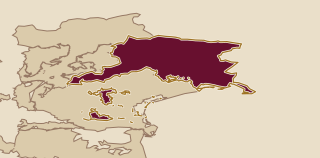
The Colli Orientali del Friuli DOC covers the eastern hills of Friuli Venezia Giulia, running southeast from the city of Udine toward the Slovenian border. The zone takes its name from the hills themselves, colli orientali meaning eastern hills, and the DOC permits a wide range of both indigenous Friulian and international grapes. Within that broad geography, Cividale del Friuli is a town with Roman and Lombard roots, and Colle Montebello is one of the named hills where the terrain breaks into the kind of steep, terraced parcels that give the appellation its most individual wines.
In the cellar
Vineyards and cellar
The terraced parcels on Colle Montebello demand hand work at every stage. The slope angle makes mechanical harvesting impractical, so grapes are picked by hand, which allows selection on the vine rather than on a sorting table after the fact. Pignolo, the variety with the longest history on these slopes, is harvested for depth of colour and a fruity aromatic profile. The marl-sandstone soils contribute a mineral character that the variety can absorb across a longer hang time.
Refosco dal Peduncolo Rosso, the other key red, is farmed for full body and the savoury grip that distinguishes it from the softer reds of the region. Wild blackberry and undergrowth aromas develop on the vine; savoury tannin builds in the cellar. The Civon blend draws on multiple varieties with composition adjusted by vintage, which gives the winemaking team a flexible tool for absorbing variation across the hillside parcels from year to year.
Wines to know
The range in view
Il Roncal produces across the Colli Orientali del Friuli DOC in both red and white categories. The indigenous reds carry the most weight in the range. Pignolo, a grape native to the Colli Orientali that came close to extinction in the mid-twentieth century, produces a wine of deep ruby colour, soft tannin, and a fruity, inviting bouquet. It is not a heavy or aggressive red; the tannin is gentle and the fruit forward. Refosco dal Peduncolo Rosso is a fuller, more savoury proposition: ruby to violet in colour, with wild blackberry and undergrowth on the nose, firm tannin, and a body that finishes dry and slightly grippy. Schioppettino completes the indigenous red trio. White wines are part of the range, and the Civon blend is a proprietary multi-variety red whose composition shifts with each vintage. At 80,000 bottles across the full range, the estate sits in mid-scale territory within the DOC, large enough to have distribution but small enough that individual vineyard character still drives the decisions.
A useful way in
A bottle to begin with
Start with the Pignolo. It is the variety most directly tied to the Colli Orientali DOC, and Il Roncal's version is built for a first encounter rather than for a cellar. Deep ruby in the glass, with a fruity and slightly floral bouquet from the marly soils of Colle Montebello. The body is medium-full and the tannin soft enough not to require years of age before the wine makes sense. A glass alongside grilled meats or aged Friulian cheese shows the estate's approach clearly: indigenous grape, terraced hillside farming, clean fruit character with gentle grip. No oak distraction, no weight that obscures the variety.