
Why it matters
The producer
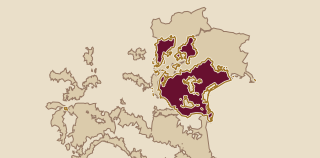
Le Tende makes Bardolino on the eastern shore of Lake Garda, where the soils are sandy and heavily calcareous and the lake moderates what would otherwise be a cooler inland climate. The estate spans 14 hectares between the villages of Colà di Lazise and Cavaion Veronese, in the Bardolino Classico zone, a designation reserved for vineyards on the original, historically mapped stretch of Bardolino country.
Two families run it. The Fortuna family, led by Mauro, directs the vineyard and the cellar. The Lucillini family contributes Franco, an entrepreneur and designer who creates the labels. That split is deliberate and visible: the bottle you pick up has been farmed by one family and designed by another. Le Tende produces around 100,000 bottles a year across Bardolino Classico, Bardolino Classico Superiore, Bardolino Chiaretto, and Custoza, a white wine DOC to the south.
Place and vineyards
Where the wines begin
Bardolino sits on the eastern shore of Lake Garda, the large glacial lake that separates Veneto from Lombardy in northern Italy. The Bardolino Classico zone covers the oldest, best-defined vineyards in the appellation, running roughly between Lazise and Bardolino along the lake's edge. Soils here are sandy and strongly calcareous, lighter and more freely draining than the clay-richer soils of Valpolicella to the northeast. That lightness reaches the wine directly: Bardolino is one of the most immediate reds in the Veneto, with low tannin, a bright acid line, and a colour closer to deep rosé than to the dense ruby of its neighbours.
The lake itself is large enough to behave as a thermal buffer. Winters are mild for the latitude; summers are warm but not extreme. Grapes ripen reliably without losing the acidity that keeps Bardolino's character as a wine of the table rather than a wine of weight.
In the cellar
Vineyards and cellar
The 14 hectares cover two appellations: Bardolino Classico and Bardolino Classico Superiore in the reds, and Custoza in the whites. Organic farming means no synthetic herbicides, pesticides, or fertilizers; vine health depends on cover crops, copper and sulphur treatments, and careful canopy management. On sandy soils, which offer less natural protection against heat and drought than clay, that requires attention to vine stress through the summer.
Corvina, the dominant red grape, is a variety known for thin skins, moderate tannin, and high acidity. In Bardolino, where it is blended with Rondinella, Bardolino uses both grapes. The Classico Superiore carries a higher ageing requirement and draws more concentration from the fruit. White wines under Custoza DOC blend Garganega, the grape also central to Soave, with Trebbiano varieties and Cortese, giving a light, aromatic white with enough body to carry food.
Wines to know
The range in view
Le Tende produces five bottlings across four appellations.
Bardolino Classico DOC is the entry red, built from Corvina and Rondinella on the estate's sandy calcareous parcels. It is pale, light-bodied, and aromatic, with the cherry-skin fruit and fresh acidity typical of the appellation at its best. Low tannin and early drinkability are part of the design.
A useful way in
A bottle to begin with
Bardolino Classico Superiore DOCG is the bottle to open first. It carries the same Corvina and Rondinella blend as the Classico but with more concentration and ageing time behind it. The wine is pale ruby, lightly aromatic, with cherry and dried herb on the nose and a mid-palate that has more grip and definition than the entry bottling. The finish is clean and mineral. Tannin is low; acidity carries it. The wine is made from Corvina and Rondinella. Serve it lightly chilled.