
Why it matters
The producer
Malibràn is a three-generation family estate farming 14 hectares of clay-dominant vineyard in Susegana, on the Treviso hills of Veneto, within the Prosecco Superiore DOCG zone. The current proprietor is Maurizio Favrel. The estate is a member of FIVI, the Federazione Italiana Vignaioli Indipendenti, and earned Biodiversity Friend certification in 2020.
Two facts separate Malibràn from most estates in the region. First, the estate has produced its Sottoriva col fondo continuously for over 50 years, in a zone where Charmat pressure-tank production long ago became the commercial norm. Second, its founding logic was explicitly agricultural: the family moved to Susegana because the clay there gave more complex wine. Those two commitments, soil choice and method loyalty, still show in every bottle.
Place and vineyards
Where the wines begin
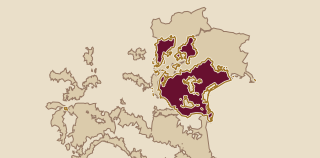
Susegana sits in the Treviso hills, east of the Piave river, at the northern edge of the Prosecco Superiore DOCG. The DOCG covers a defined band of hills between Conegliano and Valdobbiadene, and wines within it carry the Conegliano Valdobbiadene Prosecco Superiore DOCG label. Malibràn's parcels fall on the gentler slopes of Susegana rather than the steeper hillsides around Valdobbiadene, where soils tend to carry more limestone alongside clay.
The clay concentration in Susegana changes the grape. Clay retains moisture through drier summer periods, slows drainage, and encourages fuller-bodied, more aromatically rounded Glera compared to the lighter, more nervy styles from higher and stonier ground. That fuller character is audible in Malibràn's col fondo wines and in the Extra Brut dosage choice for the flagship: less sugar to balance, because the fruit arrives richer.
In the cellar
Vineyards and cellar
All parcels are hand-worked. Hand cultivation allows row-by-row assessment at harvest, selective picking by ripeness, and tighter control over fruit selection than a mechanical pass permits. On 14 hectares across multiple hillside locations, this is a considered commitment of labour rather than a practical necessity.
In the cellar, Malibràn uses two production methods. The Rive Extra Brut and the Gorio Extra Dry are made using the Charmat method, where secondary fermentation happens under pressure in sealed tanks. This gives clean, consistent bubble and preserves fresh Glera aromatics: white pear, apple blossom, and light citrus.
Wines to know
The range in view
The range runs across five sparkling wines and one still red, with Glera doing the principal work and Boschera making a single appearance.
Rive di Santa Maria di Feletto Extra Brut is the flagship. It is a single-commune Glera sparkling wine under the Rive sub-category of the Conegliano Valdobbiadene DOCG, produced by Charmat method and labelled Extra Brut, meaning very little residual sugar. The wine emphasises the clay-slope character of the Santa Maria di Feletto parcels: firmer body than typical Valdobbiadene Prosecco, with white apple and pear fruit, good acidity, and a dry, clean finish. The low dosage means the fruit rather than sweetness carries the palate.
A useful way in
A bottle to begin with
Start with the Credamora Col Fondo. It is the bottle that shows what Malibràn does differently from nearly every producer in the Prosecco zone. The method is ancestral: secondary fermentation in the bottle, no disgorgement, wine left on its yeast sediment. The name embeds the soil story (creda, clay in local dialect). The glass gives pale straw colour, fine rising bubbles, citrus and apple aromas, and a sourdough note that confirms the yeast contact. The texture is softer and rounder than Charmat Prosecco. The finish is dry. It is not a challenging wine to drink, but it is a challenging wine to confuse with anything else made in the region today.