
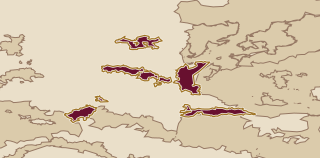
Why it matters
The producer
Massussi Luigi farms 1.5 hectares at 400 metres above sea level in Franciacorta, the DOCG sparkling-wine denomination in eastern Lombardy. At that elevation, the estate sits higher than almost any other producer in the appellation. The plot is small and the philosophy is simple: indigenous yeasts, no artificial cellar work, almost no added sugar, and extended time on lees before the wine goes out.
The family name on the label carries more than two centuries of viticultural history on the same land. Contemporary commercial production, focused entirely on sparkling Franciacorta, began in 1985, launched by Giuseppina Ruggeri, Vittorio Massussi, and Agostino. That was a decade before Franciacorta received its DOCG in 1995, placing Massussi among the founding generation of producers who built the appellation's modern technical character.
Place and vineyards
Where the wines begin
Franciacorta occupies a glacially shaped basin south of Lake Iseo in the province of Brescia. The lake moderates temperature, reducing frost risk in spring and slowing heat accumulation in summer, and the morainic soils left by the retreating glacier carry good drainage.
At 400 metres, Massussi's vineyard sits above most of the appellation. Higher elevation means cooler nights, a longer growing season, and grapes that reach harvest with firmer acidity than fruit from lower ground. That acidity is not incidental: it determines how long a sparkling wine can spend on lees without losing freshness, and it shapes the way the finished wine feels on the palate. The Millesimati wines aged here for 40 months or more carry the acidity of the altitude rather than relying on dosage or blending to create balance.
In the cellar
Vineyards and cellar
The 1.5-hectare plot is planted to Pinot Nero, Chardonnay, and Pinot Bianco, the three grapes permitted under the Franciacorta DOCG. At 400 metres, the vines ripen slowly. Indigenous yeasts drive the primary fermentation, without commercially selected strains that would accelerate or homogenise the process. Sugar addition is kept to the minimum required, and no artificial interventions are introduced in the cellar.
The Millesimati wines, vintage-dated and single-harvest, spend at least 40 months on lees after the secondary fermentation in bottle. Lees aging develops breadth, a toasty or biscuity depth, and a creamy mousse while the acidity of the elevated site keeps the wine from softening into heaviness.
Wines to know
The range in view
The range runs to six labels, combining sparkling Millesimati bottles and still wines. The sparkling wines are all Franciacorta DOCG and all vintage-dated, meaning each bottle is tied to a single harvest rather than blended across years.
The Brut Nature Rosé Riserva anchors the range. Blended from 65% Pinot Nero, 20% Chardonnay, and 15% Pinot Bianco, it is produced with zero dosage, no sugar added after disgorgement, so the final sweetness level is essentially nothing. The Pinot Nero majority drives the red-fruit character and gives the wine its colour and grip. The Chardonnay adds a citrus and floral dimension, and the Pinot Bianco brings texture and a slightly fuller mid-palate. At 40 or more months on lees, the wine develops a biscuit and brioche depth alongside the fruit, with a firm acidity underpinning the whole.