
Why it matters
The producer
The Perusi family has farmed in Valgatara since the early 1900s. The estate trades as Mizzon, a name inherited from an earlier generation, and sits in the Valpolicella Classica zone in Veneto: the historic heartland of the appellation, where the rules for Amarone della Valpolicella DOCG demand dried-grape fermentation from Corvina-dominant blends. Nicola Perusi took over his grandfather's six hectares in 2010 and runs the whole operation on that same compact holding, producing around 40,000 bottles a year.
The scale is deliberate. Six hectares across three distinct soil types in one valley gives Nicola direct control from vine to bottle without the logistical distance that separates larger Amarone houses from the parcels that feed their blends.
Place and vineyards
Where the wines begin
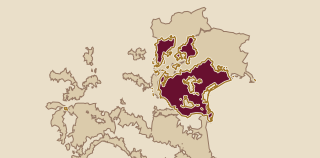
Valpolicella Classica sits immediately west and northwest of Verona, across a series of valleys that run from the foothills of the Lessini mountains down toward the Adige plain. Valgatara occupies the Marano valley, one of the three original valleys of the Classica zone. A bottle labelled Valpolicella Classica or Amarone della Valpolicella DOCG from this address comes from vines that have been tied to this specific geography since the appellation was first mapped.
The Classica designation matters on a label because it excludes the flatland extensions added to the Valpolicella zone in the 1960s. Grapes grown here ripen more slowly and retain more acidity.
In the cellar
Vineyards and cellar
Grapes destined for Amarone and Recioto go through appassimento: the controlled drying process that concentrates sugar, colour, and flavour before fermentation. At Mizzon, harvested bunches are laid on traditional arele, wood-and-cane racks stacked in the attic, and left to dry for four months. Only fans and open windows regulate the air; no industrial climate control is used. By the time the grapes are pressed, a large proportion of their water has evaporated, leaving a denser, more glycerol-rich must.
For the 2016 Amarone, skins remained in contact with the fermenting wine for nearly two months, extracting deep colour, tannin, and phenolic complexity from the partially dried fruit. After fermentation, the wine spent four years maturing in a combination of large oak casks and barriques before bottling. The amphora variant follows the same appassimento and maceration process but skips the wood entirely, which produces a different aromatic profile in the finished wine.
Wines to know
The range in view
The confirmed range at Mizzon runs to Amarone della Valpolicella DOCG, Recioto della Valpolicella, and the amphora-aged Amarone as an experimental cuvée.
The standard Amarone varies in blend composition between vintages. The 2016 carried five varieties: Corvina, Corvinone, Rondinella, Dindarella, and Oseleta. Dindarella and Oseleta are minor Valpolicella varieties with small plantings across the Classica zone; their presence in the 2016 blend signals a willingness to use what the estate grows rather than simplifying the blend toward the dominant trio. The 2017 shifted to four varieties: Corvina at 55%, Corvinone and Rondinella each at 20%, and Molinara at 5%. Blends move with the vintage at this scale.
A useful way in
A bottle to begin with
The Amarone della Valpolicella DOCG in its standard oak-aged expression is the right first bottle. It arrives with the full sequence of Mizzon's cellar work: four months of drying on arele, nearly two months of skin contact, four years in oak. The nose gives dried cherry, spice, and forest floor. The palate is firm and concentrated, with the citrus lift and almond character of the 2016 vintage cutting through the glycerol weight of the dried-grape base. The finish is long, cool, and faintly minty. Save the amphora variant for when you want to understand what the same wine does without wood.