
Why it matters
The producer
On the Moncucco hill in Santo Stefano Belbo, in the Lower Langa zone of Piemonte, Piero Gatti founded an estate in 1988 with a single aromatic grape and no ambition to buy in fruit. Every parcel belonged to the estate. Every bottle came from its own land.
The estate now runs under Barbara Gatti, who took over from her mother Rita around 2000. The handover changed the face of the estate without altering its logic: Moscato Bianco grown on south-facing hillside parcels, harvested on the vine's own schedule, and bottled as a lightly sparkling, low-alcohol sweet white. Seven hectares spread across three communes, Santo Stefano Belbo, Cossano Belbo, and Nizza Monferrato, and all of them under estate control.
Place and vineyards
Where the wines begin
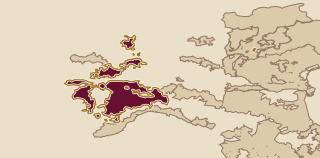
The Lower Langa is the strip of Piemonte hill country that runs south of the Tanaro river, below the more famous Barolo and Barbaresco zones. Santo Stefano Belbo sits near its eastern edge, close to where the Belbo river valley opens toward the Monferrato hills. The land here has grown Moscato Bianco for generations, and the appellation Moscato d'Asti DOCG, which sits immediately above Piemonte DOC Moscato in the hierarchy, was built around this zone.
Gatti's vineyards face south across three communes. South aspect in this part of Piemonte means reliable sun accumulation on the slopes, earlier ripening than north or east-facing parcels, and a concentration of Moscato Bianco's aromatic compounds. That ripening pattern matters for the label: Gatti bottles under Piemonte DOC rather than Moscato d'Asti DOCG, which requires compliance with a fixed harvest window. The DOC classification gives the estate the flexibility to harvest when the vine is ready rather than when the regulations permit.
In the cellar
Vineyards and cellar
All seven hectares are estate-farmed. South-facing orientation across the Moncucco hill and the two flanking commune sites accelerates ripening and concentrates Moscato Bianco's aromatic expression. Vine age ranges from parcels planted in 1955 to those planted in 1995, and the age spread contributes depth to the aromatic profile rather than uniformity.
The cellar work for the Piemonte DOC Moscato follows the method standard for frizzante sweet whites in this zone: fermentation is arrested while residual sugar remains high, approximately 140 grams per litre, and the wine retains its natural light carbonation. Alcohol stops at around 5.5%, which is low by any measure and keeps the wine's sweetness from feeling heavy. The Moscato is bottled as a vegan-certified wine.
Wines to know
The range in view
Gatti's primary wine is the Piemonte DOC Moscato, made from 100% Moscato Bianco grown across the estate's three communes. It is a frizzante sweet white at 5.5% alcohol with 140 grams per litre of residual sugar. The light sparkle is a product of arrested fermentation, not secondary carbonation, and it reads across the palate as gentle fizz rather than full effervescence.
The range centres on the Piemonte DOC Moscato. The Piemonte DOC Moscato is the estate's defining work and the wine that carries its argument.
A useful way in
A bottle to begin with
The Piemonte DOC Moscato is the only bottle to start with. It is a frizzante sweet white made from 100% Moscato Bianco grown on south-facing parcels on the Moncucco hill, harvested to the vine's natural schedule and bottled at 5.5% alcohol with 140 grams per litre of residual sugar. In the glass it is fragrant, peachy, and lightly fizzing, sweet enough to register clearly but fresh enough to drink through a warm afternoon without fatigue. The low alcohol and the natural carbonation are not compromises: they are what this grape, in this place, produces when it is left to ripen fully and bottled honestly. Open it cold. Drink it the same day.