
Why it matters
The producer
Graziano Prà founded his estate in 1983 in Monteforte d'Alpone, a village at the eastern edge of the Soave DOC in the Veneto, and became the first member of his family to bottle wine under the Prà name. That original decision gave shape to everything that followed: a single producer working two separate and geologically distinct territories, one for white wines in Soave and one for red wines in Valpolicella, using only native Veneto grapes and making every bottle without fining or filtration.
The estate now holds 30 hectares of Soave vineyards around Monteforte d'Alpone and a 7-hectare parcel in the Valpolicella zone called La Morandina, purchased and planted in 2001 at 450 metres elevation. Both holdings are certified organic. The Soave side produces the estate's main volume, anchored by the Monte Grande cuvée. The Valpolicella side produces the Morandina Superiore and an Amarone from the same chalky hillside.
Place and vineyards
Where the wines begin
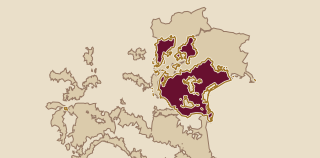
Soave sits in the eastern Veneto, its best vineyards on basalt and volcanic soils around Soave Classico and the hills of Monteforte d'Alpone. The Garganega grape, the primary variety in Soave, produces whites ranging from light and direct to weighty and age-worthy depending on yield, site, and cellar handling. Monte Grande, one of Prà's Soave parcels, is aged ten months in Allier oak, placing it at the richer end of the range.
La Morandina is geographically separate, further north and west in the Valpolicella zone, 450 metres above the valley floor. That altitude keeps temperatures cooler and ripening slower than the traditional Classico zone below, altering the character of the Corvina, Corvinone, and Rondinella grown there. The appellation on the red bottles reads Valpolicella Superiore DOC or Amarone della Valpolicella, depending on whether the grapes go directly to fermentation or pass through a two-month drying period on wooden racks.
In the cellar
Vineyards and cellar
Every grape across both territories is harvested by hand. Fermentation runs on natural yeasts only, without inoculation. No fining agents are added. No filtration takes place before bottling. These are choices that leave the wines closer to what the vineyard delivered: a wine made this way carries more textural life but also shows clearly what the fruit was doing in that vintage.
Wines to know
The range in view
The range divides cleanly between Soave and Valpolicella. On the Soave side, the 30-hectare holding produces white wines from Garganega and Trebbiano di Soave, with Monte Grande as the estate's flagship white. Ten months of ageing in Allier oak gives it more weight and a rounder mid-palate than lighter Soave styles: there is texture there, a fuller body, and a slow finish.
The Morandina Valpolicella Superiore opens with dark cherry and a faint earthy quality, rising from the glass without heaviness. In the mouth it is light to medium in body, with the 15-day skin contact giving grip without hardness. The finish is dry, slightly earthy, and resolves cleanly. There is no obvious oak character. What the chalk does is audible in the finish: a mineral dryness that shortens the aftertaste and keeps the wine feeling bright despite the red grape weight.
A useful way in
A bottle to begin with
Start with the Morandina Valpolicella Superiore. It is Corvina, Corvinone, and Rondinella in equal thirds, grown on ancient seabed chalk at 450 metres, fermented in stainless steel with natural yeasts, and bottled without fining or filtration. The wine is transparent ruby, light in body, and built for a weeknight table rather than a cellar. Dark cherry and earth come first, then a dry, mineral finish that comes directly from that chalky soil. No oak flavour, no extracted weight. It is Prà's farming and soil philosophy in a glass: native grapes, high altitude, nothing added, nothing taken away.