
Why it matters
The producer
Roberto Voerzio founded this estate in 1986 on two hectares in La Morra, a village in the Langhe hills of Piedmont whose Nebbiolo vines produce some of the most recognisable Barolo in Italy. The estate has grown to 35 hectares, with 14 hectares classified as Barolo cru parcels across six named vineyards: La Serra, Brunate, Cerequio, Rocche dell'Annunziata, Fossati, and Sarmassa.
What Voerzio built over the following two decades was not a larger estate so much as an increasingly concentrated one. He planted at densities of 8,000 to 9,000 vines per hectare on twelve of those fourteen cru hectares, roughly double the conventional Piedmontese norm, and reduced the yield per vine from 1.5 kilograms to approximately 500 grams. At that density and that output, each vine produces fruit closer to the weight of a large apple. The maths are deliberate: more roots competing for the same soil, less fruit per plant, deeper extraction from each grape.
Place and vineyards
Where the wines begin
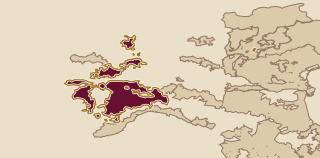
La Morra sits in the northwestern corner of the Barolo production zone, a DOCG appellation in the Langhe hills of southern Piedmont. The Barolo zone covers eleven communes, and La Morra produces wine with a character distinct from Serralunga d'Alba or Castiglione Falletto to the east and south. The soils here are Tortonian in age, composed of compact Helvetian marls, which tend to give Nebbiolo from this part of the zone a more rounded, aromatic, and earlier-maturing character than the iron-rich Serravallian soils further east.
On the label, this translates directly. A Voerzio Barolo carries the name of its cru below the appellation: Barolo La Serra, Barolo Brunate, Barolo Cerequio. Each cru sits in La Morra or straddles its boundary with a neighbouring commune, and each is vinified separately. The range is cru-specific from the ground up.
In the cellar
Vineyards and cellar
Fermentation in tank lasts 15 to 30 days, depending on the vintage and the cru. Skin contact within that window extracts colour, tannin, and aromatic compounds from Nebbiolo without the lengthy macerations that can produce dry, astringent wines requiring a decade of bottle ageing before they open. Ageing follows in French oak: a combination of 225-litre barriques and larger botti. The barrique adds vanilla, spice, and a degree of oxidative softening. The botti preserve more primary fruit character and allow slower development.
The Barbera and Dolcetto parcels outside the Barolo crus serve a different vineyard function: they provide cash flow at lower price points and give the estate's farming team year-round engagement across a broader portfolio.
Wines to know
The range in view
The range divides into two clear tiers. At the top sit six single-vineyard Barolos, each carrying its cru name: La Serra, Brunate, Cerequio, Rocche dell'Annunziata, Fossati, and Sarmassa. Below them, Barbera and Dolcetto from La Morra provide earlier-drinking, lower-priced wines from the same farming philosophy.
The Barolos share the high-density, low-yield foundation, but each cru occupies a distinct position within La Morra and the broader Barolo zone. Brunate and Cerequio straddle the La Morra boundary, producing wines with a floral lift and mid-weight body typical of Tortonian soils. La Serra sits entirely within La Morra and tends toward more accessible, aromatic Nebbiolo. Rocche dell'Annunziata, one of La Morra's most prized single sites, typically yields Barolo with more depth and ageing potential. Fossati and Sarmassa round out the portfolio with their own site characters.
A useful way in
A bottle to begin with
Start with Barolo La Serra, a cru entirely within La Morra planted on Tortonian marls, vinified separately from the high-density, low-yield vines, and aged in French barriques and botti.