
Why it matters
The producer
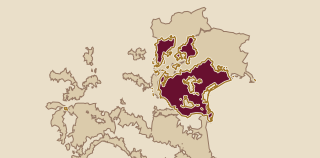
Roncolato farms both sides of a divide that most Veneto producers choose one side of. The estate's 30 hectares sit partly in the volcanic hills of Soave Classico, east of Verona, where Garganega gives pale, floral whites, and partly in the hills of Valpolicella to the west, where Corvina and its blending partners build the dried-grape reds that have made northeastern Italy famous. The Roncolato family had vineyards in these hills from the mid-nineteenth century. Commercial bottling under the family name began in 1980.
That span, white wine country and red wine country under a single estate, shapes how the range works. The lightest bottle is the steel-fermented Soave Carcera at 12 percent alcohol. The heaviest is the Amarone della Valpolicella at 15 percent, built from grapes dried for several months before fermentation. Between those two points the estate covers Recioto di Soave, Pinot Grigio, a Brut sparkling white, Valpolicella DOC, Ripasso, and a Passito del Veneto. Few Veneto estates run both ends of that spectrum from their own ground.
Place and vineyards
Where the wines begin
Soave Classico is the historic inner zone of the broader Soave DOC, centred on volcanic basalt soils in the hills around the villages of Soave and Monteforte d'Alpone. The volcanic geology here gives Garganega its mineral lift and moderate alcohol. Soave Classico on the label signals grapes from this original, hillside zone rather than the extended flatland vineyards that diluted the appellation's reputation through the 1970s and 1980s.
Valpolicella DOC occupies the hills and valleys northwest of Verona. The three main grape varieties, Corvina, Corvinone, and Rondinella, are grown here across a range of styles from fresh and light to the full Amarone. The appellation's most distinctive technique is appassimento: harvested grapes are dried on bamboo racks for months, losing water and concentrating everything else. Sugar, colour, aroma, and phenolic weight all increase before fermentation begins. Amarone ferments fully dry despite that concentration, which is where the 15 percent alcohol comes from and where the wine's dark, dense character originates.
In the cellar
Vineyards and cellar
Harvest at Roncolato is done in multiple passes through the vineyard, with pickers returning to the same rows as different bunches reach full ripeness. Selective picking takes longer than a single mechanical sweep and keeps unripe or compromised fruit out of the cellar. For the Amarone, Ripasso, Recioto di Soave, and Passito, the selected bunches go to drying lofts rather than directly to fermentation.
Appassimento for the Amarone means the grapes rest on bamboo racks for several months after harvest, losing roughly 30 percent of their weight as water evaporates. What remains is richer in sugar, colour, and aromatic compounds. Fermentation then runs long and dry, converting those elevated sugars to the 15 percent alcohol in the finished wine. The Ripasso takes a shorter route: Valpolicella DOC wine is re-fermented over the pressed Amarone skins, picking up body, colour, and some dried-fruit character without the full appassimento process.
Wines to know
The range in view
The white range opens with Soave Carcera, the steel-fermented Garganega from Soave Classico, at 12 percent alcohol: pale straw in colour, with a delicate floral nose and the light body typical of this appellation when harvested at correct ripeness. A separate wood-aged Soave Classico adds a second tier, broadening the mid-palate through oak contact while keeping the appellation's acidity. Recioto di Soave DOCG is the sweet white, made from dried Garganega by the same appassimento method used for Amarone: honeyed, with more weight and concentration than the dry Soave, and classified under its own DOCG. A Pinot Grigio and a Brut sparkling dry white complete the white side.
Appassimento runs through both halves of the range. Recioto di Soave is the dried-grape white. Amarone is the dried-grape red. That parallel is not common to most Veneto producers who do not hold ground in both appellations.
A useful way in
A bottle to begin with
Start with the Amarone della Valpolicella. It is made from dried grapes before fermentation. Corvina 50 percent, Corvinone 25 percent, Rondinella 20 percent, Oseleta 5 percent, all dried on bamboo racks before fermentation, all pressed and fermented fully dry to 15 percent alcohol. The Amarone has dark plum and baked cherry on the nose, with anise and oak spice through the mid-palate. The 2015 vintage carries a 92 out of 100 score. Open it with a meal that can match the weight, lamb or aged beef or braised venison, and give it an hour in a wide decanter to let the dried-fruit concentration open.