
Why it matters
The producer
Azienda Agricola SETE farms recovered old-vine plots in the Amaseno Valley, a stretch of agricultural land in southern Lazio where heritage grapes survived for a century in parcels that commercial winemaking had largely set aside. Emiliano Giorgi and Arcangelo Galuppi, childhood friends from Priverno, founded the project in 2013 after Giorgi spent two consecutive harvests at Le Coste di Gradoli, a small estate on volcanic soil in northern Lazio that was one of the first in Italy to work without correction. He came back to Priverno with a clear objective: find the old vines, work with local elderly farmers by purchasing their grapes or renting their vineyards, and make wine without adding or taking anything away.
The name SETE means thirst in Italian. It is a two-person project farming 4.5 hectares across twelve individual plots, each one recovered from abandonment by hand. The vines range from fifty to over one hundred years old. Every plot is cultivated without synthetic chemicals or fertilisers.
Place and vineyards
Where the wines begin
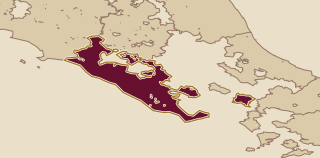
Priverno sits in the lower Lazio plain about 100 kilometres south of Rome, close to the Aurunci mountains and the inland stretches of the Amaseno river valley. The valley sits far enough from the coast to avoid the sea moderation that shapes wine further west, and far enough inland to hold summer heat that pushes grapes toward full ripeness.
What the valley does hold is old planting. The particular combination of grape varieties that survived here, including Ottonese alongside the Trebbiano and Malvasia that appear across central Italy, reflects decades of mixed agricultural farming where varieties were grown for local use rather than for market appeal. That combination is what makes SETE's wines geographically specific rather than categorically natural.
In the cellar
Vineyards and cellar
The twelve plots are cultivated without synthetic chemicals or fertilisers, and recovery from abandonment was done by hand. Vine age across the estate runs from fifty to over a century. Old vines tend to produce lower yields and more concentrated fruit, and in a warm inland valley that concentration translates to ripeness with body rather than weight.
In the cellar, fermentation begins spontaneously with wild yeasts. Nothing is added: no cultured yeast, no sulfites at any stage. Safara spends two days on the skins before pressing. Tannin extraction at two days is gentle rather than aggressive, giving the wine texture and a light amber hue without the grip of a longer maceration. The wine then ages for eight months in stainless steel, which keeps the fruit and aromatic character from skin contact intact rather than overlaying oak. The wine leaves the cellar unfined and unfiltered.
Wines to know
The range in view
Safara is the estate's defining wine and the one with full confirmed production detail. It is a skin-contact white built from 60 per cent Trebbiano, 30 per cent Ottonese, and 10 per cent Malvasia Puntinata, with an alcohol of 12 per cent.
A useful way in
A bottle to begin with
Sete Safara is the first bottle. It is a skin-contact white at 12 per cent alcohol, made from old-vine Trebbiano, Ottonese, and Malvasia Puntinata grown in twelve recovered plots in the Amaseno Valley. Two days on the skins give it a faint amber colour and mild tannin without making it heavy. Eight months in stainless steel keep the fruit and acidity clean. The wine is dry, aromatic, and lively, with stone fruit, acacia honey, and a finish that has more grip than a conventionally pressed white.