
Why it matters
The producer
Suavia sits in Fittà, a small village at the geographic heart of Soave Classico, and it makes only one kind of wine: white Veneto from the two native varieties, Garganega and Trebbiano di Soave. No other grape enters the cellar.
The Tessari family tended vineyards in the Soave hills from the late 1800s. For more than a century, the grapes went to other producers. In 1982, Giovanni and Rosetta Tessari changed that. They crushed their own fruit, bottled it under their own name, and founded what would become one of the most closely watched estates in the Soave Classico zone. Eight years later they built a modern winery beneath the family home that had stood in Fittà since 1887. The building has not moved; the cellar simply grew downward.
Place and vineyards
Where the wines begin
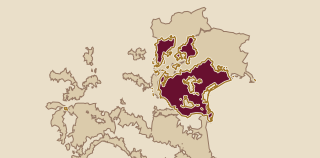
Soave Classico is the original, historic core of the Soave appellation, a compact zone of volcanic hills west of the medieval town of Soave in the Veneto. It is legally distinct from the larger Soave DOC, which extends into flatter, less expressive ground. Wines from the Classico zone must come from the hillside parcels where Garganega has been planted for centuries.
Fittà sits at the centre of this zone. Suavia's vineyards climb to roughly 300 metres, or about 1,000 feet, above the valley floor. At that elevation, cooler nights slow ripening through summer and extend the growing season into autumn, which sharpens acidity.
In the cellar
Vineyards and cellar
The Monte Carbonare vineyard sits on basalt at roughly 300 metres elevation in Soave Classico. The volcanic soil and altitude combine to slow the Garganega vine through the growing season, concentrating flavour while keeping acidity high. Low yields from old vines on volcanic ground produce fruit with more depth and mineral character than the same variety planted on flat, alluvial soil in the broader appellation.
The winery beneath the family home in Fittà handles vinification. The 1990 build brought modern production capacity into a building that has been the Tessari address for nearly 140 years. Fermentation happens close to where the family lives, which is not unusual in the Soave Classico zone but is unusually literal at Suavia, where the cellar shares foundations with the original house.
Wines to know
The range in view
Suavia's range is built entirely on the Soave Classico DOC and the two native varieties: Garganega, which provides the aromatic core, and Trebbiano di Soave, which is not the neutral Trebbiano Toscano found across central Italy but a distinct Veneto variety that adds body and aromatic roundness when blended.
Monte Carbonare is the single-vineyard wine at the top of the range. It is pure Garganega from volcanic basalt at altitude, and it carries the clearest expression of what the Soave Classico hillsides can do. The nose opens on apricot, lime peel, and melon, then shifts to a smoky, stony minerality that comes directly from the basalt soil. On the palate, citrus and stone fruit dominate, supported by firm acidity and a savory, taut finish. Antonio Galloni scored it 94 points, describing the bouquet as flint stones and white smoke with inner sweetness balanced by saline mineral tones. Robert Parker awarded 92, noting mid-weight texture, plump fruit of peach and melon, and a citrus-mineral finish.
A useful way in
A bottle to begin with
Monte Carbonare Soave Classico is the bottle that shows what Suavia is. It is pure Garganega from a single named vineyard on volcanic basalt, fermented and aged in the cellar beneath the family home in Fittà, and it carries everything the estate has argued for since 1982: that Garganega on old volcanic ground in the Classico zone makes a white wine with mineral depth, firm acidity, and a savoury finish that very little Italian white can match at the price. The nose is stony and smoky; the palate is precise, textured, and long. Start here.