
Why it matters
The producer
Du Riva, the estate's Dolcetto d'Ovada Superiore, won Gambero Rosso's Tre Bicchieri for 13 consecutive years, and did so as the first wine from the Ovada appellation to reach that tier. That run did not happen because Dolcetto d'Ovada was already a fashionable address. It happened because Azienda Agricola Tacchino committed to a rare local clone, a particular ageing method, and a level of patience unusual for a grape variety normally bottled young and drunk within a year or two.
The estate sits in Castelletto d'Orba, a village in the Alto Monferrato hills of southeastern Piemonte. Third-generation siblings Alessio and Romina Tacchino manage 12 hectares split between Castelletto d'Orba and the hillside commune of Lerma. Dolcetto fills the core of their work, with Cortese for a Gavi di Gavi and Barbera rounding out the range.
Place and vineyards
Where the wines begin
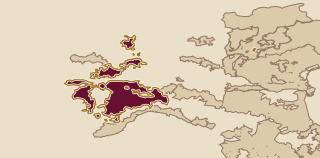
Castelletto d'Orba sits in Alto Monferrato, the southern spur of Piemonte's Monferrato wine country, close to the Ligurian Apennines. The surrounding hills fold the vineyards into a naturally sheltered basin. The soils here carry a high proportion of volcanic ash, which drains well, retains enough heat, and contributes to the aromatic character and colour depth in the red wines.
The appellation matters: Dolcetto d'Ovada Superiore is a step above standard Dolcetto d'Ovada DOC, carrying a minimum ageing requirement that pushes producers toward wines meant to develop rather than be opened immediately. That legal minimum aligns with how Tacchino builds Du Riva: steel fermentation, then an extended rest in bottle before anything leaves the cellar.
In the cellar
Vineyards and cellar
All 12 hectares are dry-farmed. No irrigation means the vines draw entirely from whatever moisture the soil holds between rains, keeping yields in check and concentrating the fruit. Every harvest is done by hand at peak ripeness in autumn, a choice that allows lot-by-lot selection rather than mechanical uniformity.
The nibiu clone of Dolcetto is the heart of the Du Riva protocol. Nibiu is a low-yielding variant: it produces fewer grapes per vine than standard Dolcetto selections, but what it does produce is riper and denser. The smaller crop concentrates sugar, colour compounds, and the fruit aromatics that define the wine's nose. Without the nibiu selection, Du Riva would be a different wine at a different level.
Wines to know
The range in view
The range is built on two contrasting bottles.
Du Riva, Dolcetto d'Ovada Superiore is the flagship. Made from nibiu-clone Dolcetto on the Castelletto d'Orba and Lerma parcels, it is a dark-fruited red with the density that comes from low yields and the coherence that comes from 36 months of bottle ageing. The palate on the 2019 vintage was described as intense and expansive, with prominent fruit aromatics and a powerful character. No barrel contact means no oak overlay.
A useful way in
A bottle to begin with
Start with Du Riva, Dolcetto d'Ovada Superiore. Choose it over the Gavi because it explains what makes this estate different from every other small Piemonte producer working with multiple varieties. The nibiu clone, the all-steel cellar, and three years in bottle before release are all decisions that push against how Dolcetto is normally handled, and the wine in the glass reflects those decisions clearly. Dark fruit, firm tannin, no oak character, and a coherence in the mid-palate that takes most Dolcetto two or three years in barrel to approach. Open it with a plate of braised meat or aged cheese, or hold it for a further two years.