
Why it matters
The producer
The Zanoni family farmed vineyards in the hills north of Verona throughout the twentieth century. Pietro Zanoni took formal charge in 1998 and replanted the estate to a high density guyot trellis system, cutting yields and changing the raw material entering the fruttaio. No new label, no new appellation, no consultant. The change was agronomic and quiet, aimed entirely at cutting yields and pushing ripeness in the fruit that would eventually spend approximately 100 days drying in the ventilated fruttaio.
The estate covers approximately 8 hectares spread across three named properties, Avesa, Persona, and Quinzano, all within the Valpolicella appellation on the hillsides above Verona. The winery occupies the Zovo district. Pietro makes two wines: an Amarone della Valpolicella DOCG and a Valpolicella Superiore DOC. That is the entire range. The narrowness is deliberate: every decision in the vineyard and cellar feeds one of two bottles.
Place and vineyards
Where the wines begin
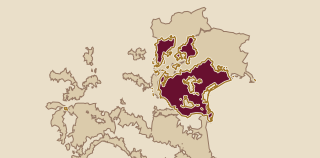
Valpolicella is a wine zone in western Veneto, beginning just north of Verona where the Lessini hills push toward the Adige valley. The name covers three legal categories that matter for labels: Valpolicella DOC (the entry level), Valpolicella Superiore DOC (a step up in minimum ageing), and Amarone della Valpolicella DOCG, the appellation's concentrated dried-grape wine and its most serious expression. Zanoni's three properties occupy the hillside terrain north of Verona within the Valpolicella appellation.
The hills are important for one practical reason: the fruttaio. The Amarone method depends on drying harvested grapes for several months before fermentation, and the elevation brings cooler air and reliable ventilation through the drying rooms. A warm, still valley floor would rot the grapes rather than desiccate them. The Valpolicella hills are, among other things, a climatic prerequisite for the wine.
In the cellar
Vineyards and cellar
High-density guyot planting pushes each vine to ripen fewer bunches. The discipline is in the selection: at harvest, the team chooses only the loosest-packed clusters, the ones with enough space between berries for air to circulate freely during drying. Tightly packed bunches stay on the vine or go to the Superiore. This sorting decision, made bunch by bunch, determines what enters the fruttaio.
For the Amarone, selected bunches are arranged in small wooden boxes and carried into a ventilated drying loft. After approximately 100 days, the grapes reach an adequate level of raisining. Fermentation runs 21 to 28 days with punch down and pump over. Bottles rest horizontally for at least 24 months before release.
Wines to know
The range in view
Zanoni makes two wines that span the full amplitude of Valpolicella.
Amarone della Valpolicella DOCG is blended from 45 percent Corvinone, 45 percent Corvina, 5 percent Rondinella, and 5 percent Oseleta, reaching 16.5 percent alcohol. The blend splits Corvinone and Corvina equally. Corvinone comprises 45 percent of the Amarone blend. Oseleta, a minor indigenous variety, comprises 5 percent of the Amarone blend. The combination, after 100 days of drying, produces a dense, warm red with concentrated red fruit, firm tannins, and ageing potential of up to 15 years from harvest.
A useful way in
A bottle to begin with
Start with the Amarone della Valpolicella DOCG. It is the wine every decision at Zanoni points toward: the guyot replanting for tighter yields, the autumn harvest selection by cluster density, the 100 days in the fruttaio. At 16.5 percent alcohol with velvety tannins and sweet-and-sour cherry aromas threaded through with tobacco and herb, it is a wine of physical weight and considerable length. It is also the clearest illustration of what the Valpolicella hills make possible: a wine that begins not at the winery but in a ventilated room full of slowly drying grapes, months before fermentation ever starts.