
Why it matters
The producer
Benjamin Zidarich farms 8 hectares of vines on the Carso plateau behind Trieste, a thin-soiled limestone tableland that most of the wine world has never heard of and that shapes everything he makes. He works without chemical inputs, without selected yeasts, and bottles without filtration. His frame for this is vini veri: real wines, made as directly as the land allows.
The range is narrow by design. Three indigenous grapes, one red and two whites, all grown in the commune of Duino Aurisina near the village of Prepotto. The Teran travels furthest, found on wine lists in New York and Copenhagen. The two whites, Vitovska and Malvasia Istriana, are made with skin maceration and carry the plateau's mineral grip in amber-coloured bottles.
Place and vineyards
Where the wines begin
The Carso is the Italian name for the Karst, the limestone plateau that rises steeply behind Trieste and continues east toward Slovenia. The soil is thin almost everywhere: wind-scoured, full of rock, with almost no water retention. Vines push roots deep into fissures to survive. The result, in both red and white, is naturally low yields and wines with sharp acidity and a mineral quality that comes directly from what the roots are drinking.
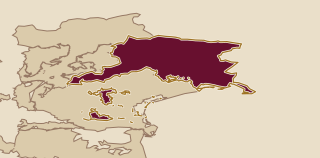
The label on Zidarich's Teran reads Venezia Giulia Rosso. Venezia Giulia is the broader geographical indication covering the northeastern corner of Italy where Friuli meets the Adriatic. The Carso DOC exists as a tighter appellation within this zone, but Zidarich bottles his Teran under the wider Venezia Giulia IGT designation. Both names appear on the map; the IGT gives producers more flexibility in grape blending and winemaking choices while still anchoring the wine to the same limestone plateau.
In the cellar
Vineyards and cellar
The 8 hectares are planted across the plateau in the thin, rocky soils typical of Duino Aurisina. No herbicides, no synthetic treatments. The vines are managed to produce low yields: the limestone drainage and wind exposure do much of that work without deliberate crop reduction.
In the cellar, fermentation runs on indigenous yeasts only. The whites, Vitovska and Malvasia Istriana, ferment and macerate on their skins. The skin contact gives the wines amber colour and tannin grip, and it extracts the mineral compounds that the limestone soils concentrate in the grape skins. Bottling happens without filtration, so the wines carry texture and cloudiness rather than a polished commercial clarity.
Wines to know
The range in view
Vitovska is the Carso's most distinctive white grape and the wine Zidarich produces that is hardest to compare to anything else. The skin maceration gives it amber colour and a dry grip that is closer to a light red than a conventional white. Exact tasting notes on Zidarich's Vitovska are not fully confirmed in current sources, but the method and the grape's naturally high acidity produce a wine with mineral pull and textured weight.
Malvasia Istriana, grown across the northeastern Adriatic coast from Friuli into Istria, is also made with skin contact at Zidarich. The grape's natural aromatic profile, stone fruit and white blossom in conventional versions, becomes tighter and more structured with extended maceration. Again, specific sensory breakdown for this cuvee is not fully documented in current sources.