
Why it matters
The producer
Umani Ronchi was founded in 1957 at Cupramontana, a hillside town in the inland arc of hills that defines the Verdicchio dei Castelli di Jesi Classico zone. The Bianchi-Bernetti family has owned the estate since that first vintage. Michele Bernetti now runs the operation day to day, with his father Massimo as chair.
From that single Verdicchio origin, the estate expanded across sixty years into 210 hectares of vineyards spread across ten districts in Marche and Abruzzo. The expansion did not drift toward international varieties. The family doubled the vineyard area from the 1970s onward, replanted 85 percent of older vines, and recovered Pecorino and Lacrima di Morro d'Alba, two indigenous varieties that had nearly disappeared from the region, alongside the Verdicchio and Montepulciano that remained the commercial anchors. In 2024, Gambero Rosso named Umani Ronchi Italian Winery of the Year, placing a Marche estate at the head of a national competition for the first time.
Place and vineyards
Where the wines begin
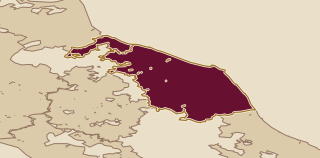
Marche runs along the Adriatic coast of central Italy, a region of parallel ridges descending from the Apennines toward the sea. The Verdicchio dei Castelli di Jesi Classico zone occupies the inland hills around Jesi, south of Ancona, where limestone soils, elevation, and diurnal temperature shifts combine to produce a white grape of notable acidity and aromatic complexity. Cupramontana sits near the heart of this zone.
Verdicchio is not a grape that trades on oak or alcohol. The variety produces wines of natural freshness, marked by a slight bitter almond note on the finish that is its most identifiable characteristic, and an acid line that allows extended cellaring when the winemaking supports it. The Classico Superiore designation requires higher minimum alcohol and longer ageing than the base DOC, which is why both Vecchie Vigne and Historical carry it on the label.
In the cellar
Vineyards and cellar
Organic farming across all 210 hectares was adopted as a practical viticulture decision: the estate has described it as a technical choice rather than an ideological one, driven by the need for balance across diverse soil types and multiple districts. No synthetic herbicides or pesticides means the vine root systems must work harder, which reduces yields and intensifies the flavours that reach the tank.
In the cellar, the two Verdicchio expressions show contrasting approaches to the same grape. Vecchie Vigne is fermented in steel at 16 to 18 degrees Celsius over 10 to 15 days, with no malolactic fermentation, and aged for ten months in concrete tanks on fermentation yeasts before six months in bottle. The decision against malolactic conversion preserves the grape's malic acidity, keeping the wine taut and aromatic. The concrete contact with lees adds a slight textural weight without softening the acid line.
Wines to know
The range in view
The range anchors on Verdicchio dei Castelli di Jesi Classico Superiore across two bottles that show what the grape becomes at different investments of time.
Vecchie Vigne is Verdicchio from old vines, vinified in steel and aged on concrete lees for ten months. It is the estate's cleaner, more immediately aromatic expression: white flowers, citrus pith, and a bitter almond note on the finish that is characteristic of the variety. The firm acidity carries through without weight.
A useful way in
A bottle to begin with
Historical Verdicchio dei Castelli di Jesi Classico Superiore is the bottle to open first. It is 100 percent Verdicchio from 50-plus-year-old vines at Montecarotto, hand-harvested, and held for five years before release. The balsamic, anise, and almond complexity on the nose is unlike most Italian white wines, and the finish runs longer than almost any white the region produces at any price. The nose carries balsamic nuances, anise, almonds, and white fruit, followed by a bright, incredibly long finish.