
Why it matters
The producer
Gianni Doglia built his estate around a single conviction: that Moscato d'Asti, the gently sparkling, low-alcohol white from Muscat Blanc grapes grown in the Asti hills, deserves as much attention in the cellar as any Piemontese red. More than half of the 110,000 bottles he produces each year are Moscato d'Asti DOCG, roughly 60,000 bottles, a commitment so concentrated that it defines how the whole range is understood.
The estate sits in Castagnole delle Lanze, a village in the Asti province that carries none of the glamour attached to Barolo or Barbaresco country further north. Gianni studied enology and viticulture at the University of Turin, then returned in 2000 to take direct charge of the winery his grandfather had founded. His sister Paola joined in 2013 and manages commercial and administrative work. The operation is compact, family-run, and focused.
Place and vineyards
Where the wines begin
Castagnole delle Lanze sits in the southern Asti province, a rolling landscape of hilltop villages and mixed agricultural land that stretches between the Tanaro and Belbo rivers. The estate vineyards spread across three municipalities: Castagnole delle Lanze at the headquarters, Coazzolo to the north, and Nizza Monferrato to the southwest. The Nizza Monferrato parcels fall within the Nizza DOCG, a sub-zone carved from the broader Barbera d'Asti denomination for its concentration of older Barbera vines.
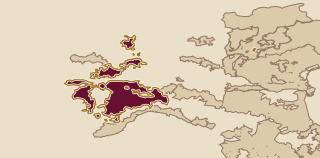
Moscato d'Asti DOCG covers a large arc of hillside territory across the Asti, Cuneo, and Alessandria provinces, with the right to the name tied to Muscat Blanc grapes grown within that designated area. The appellation demands low alcohol, typically between 5% and 5.5%, preserved sweetness, and a soft natural mousse rather than a full Champagne-method sparkle. Castagnole delle Lanze falls well within that zone, and the cooler, elevated vineyard sites there hold the acidity that keeps Moscato from tipping into flatness.
In the cellar
Vineyards and cellar
Sixteen hectares are farmed across the three municipalities. The Moscato parcels supply Muscat Blanc grapes harvested at full aromatic ripeness, when the characteristic peach and orange blossom scents are at their most concentrated.
In the cellar, Moscato d'Asti is made by the Martinotti method, also called Charmat, where the second fermentation takes place in a pressurised tank rather than in bottle. Fermentation is halted at around 5.5% alcohol by chilling the tank and filtering off the yeast. This stops fermentation before the residual grape sugars are consumed, leaving both natural sweetness and dissolved carbon dioxide in the wine. Moscato d'Asti has light effervescence, and a wine that retains the direct aromatics of the fresh grape rather than picking up bready or autolytic character from long lees contact.
Wines to know
The range in view
Moscato d'Asti DOCG accounts for roughly 55% of total production and comes in two versions. La Giostrina is the lighter, more immediate of the two: yellow peach, fresh mint, and sage on the nose, soft mousse, low alcohol, and sweetness cut by the grape's native acidity. Casa di Bianca is the longer-aged Moscato, with six months of lees contact in closed tank adding white peach, jasmine, and mint to the aromatic profile and a denser, more textured palate with greater aromatic length.
La Giostrina opens with yellow peach, mint, and sage, the aromatic signature of Muscat Blanc grown at altitude in the Asti hills. The mousse is fine and persistent, lower in pressure than a Prosecco, and it lifts the aromatics rather than subduing them. On the palate, sweetness arrives first, then the grape's acidity moves in from the sides and keeps the wine alive through to the finish. The alcohol is low, around 5.5%, which makes the finish clean and short rather than warming.
A useful way in
A bottle to begin with
Start with La Giostrina Moscato d'Asti DOCG. It is the most direct statement of what Gianni Doglia does with Muscat Blanc: low alcohol at around 5.5%, soft but lively mousse, peach and mint and sage on the nose, and a palate where sweetness and acidity run in close balance from the first sip to a clean, refreshing finish. No oak. No weight. Nothing that deflects from the grape and the place. It is the wine around which the estate was built, and it is the clearest way into understanding why a winemaker would stake half his annual production on a single DOCG.