
Why it matters
The producer
Nervi Conterno farms 28.5 hectares of Nebbiolo in Gattinara, a small DOCG appellation in Alto Piemonte, roughly 80 kilometres north of the Langhe. The estate produces three wines: an estate Gattinara Nebbiolo and two single-vineyard bottlings from parcels, Molsino and Valferana, whose names appear in Gattinara's town archives dated 1471 and 1231 respectively.
Roberto Conterno, who runs Giacomo Conterno in Barolo, acquired 90 percent of Nervi in April 2018 and became sole owner in 2022. He is a Barolo proprietor who chose an Alto Piemonte cru over a Barolo village as his expansion. The choice said something about where he thought the Nebbiolo grape could still surprise.
Place and vineyards
Where the wines begin
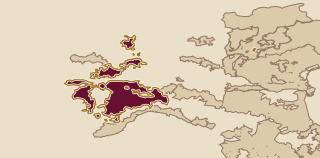
Gattinara sits in the Vercelli hills, north of the Po plain and well above the limestone-dominated geology of Barolo and Barbaresco. The soil here is volcanic porphyry and mineral-rich clay, a combination that pushes Nebbiolo toward higher natural acidity and a pronounced saline, mineral quality that rarely appears in the Langhe wines. The appellation is small and largely surrounded by agricultural land, with the vine-planted slopes concentrated on the hillsides directly above the town.
On a label, Gattinara DOCG means 100 percent Nebbiolo, a minimum of 35 months ageing with at least 18 in oak, and single-vineyard designations allowed for specific approved crus. Molsino and Valferana are two of those crus, and the town archive records place them among the longest-documented vineyard parcels in northern Italy.
In the cellar
Vineyards and cellar
Every vine is hand-pruned and hand-harvested. After picking, the grapes ferment in stainless steel with a minimum 15-day post-alcoholic maceration, a long extraction phase that builds tannin mass and colour in Nebbiolo without browning the fruit. Malolactic fermentation happens in oak barrels, which begins to integrate the acid. The wine then spends 30 months in large oak casks, long enough for the tannins to soften and the fruit to shed its primary brightness and take on secondary depth.
The cellar now has separate temperature and humidity zones for different stages of conservation, a detail that matters in a wine meant to spend years in bottle before it opens fully.
Wines to know
The range in view
The range runs three bottles, all Nebbiolo, all Gattinara DOCG.
The Gattinara Nebbiolo is the estate wine, drawn from across the 28.5-hectare holdings. It shows crushed red berry fruit, cinnamon, and orange peel with bright saline notes and finely grained tannins. It is the most accessible bottle in the range and the one that most clearly demonstrates the difference Gattinara soil makes: that saline, mineral lift is the signature the porphyry and clay produce, and it is immediate in this wine.
A useful way in
A bottle to begin with
Start with Vigna Valferana. It is a west-facing single-vineyard Gattinara from a parcel with town archive records going back to 1231, and it is the bottle that most clearly reads as Gattinara rather than as a Barolo approximation. The west exposure keeps the fruit precise and the acidity vivid. In the glass it opens with dried cherry, orange peel, and a distinct mineral note, then moves through a firm, saline mid-palate with fine tannins and finishes long and dry. There is no excess, no weight, no sweetness. It is a wine to drink alongside food, to return to over several years, and to understand as Nebbiolo on volcanic soil rather than limestone.